Tuesday, May 03, 2011

Lessons Learned - Behind the $430m Wickenby saga

Lessons Learned - Behind the $430m Wickenby saga

Part I: Hundreds of celebrities, business people and tax specialists have been caught in Project Wickenby. Neil Chenoweth | Fiona Buffini | Hannah Low *Updated Jun 2, 2011 – 5.10pm, first published at May 3, 2011 – 12.01am 
 Adam Hargraves isn’t formal about nightwear, so when the federal police turned up at his Sanctuary Cove home at 7am, the Porsche-loving businessman was protecting his valuables with only a throw cushion. 
Twenty kilometres down the road, moments before the federal police walked in, a frantic office manager threw an accounts book out the 11th floor window. 
Across the country in Perth, former rock star Glenn Wheatley was woken by a call from his wife saying more than 20 police had turned up with a warrant to search their Melbourne home and had been “literally going through everything". It was Thursday, June 9, 2005 – the day Australia’s biggest tax investigation went public.
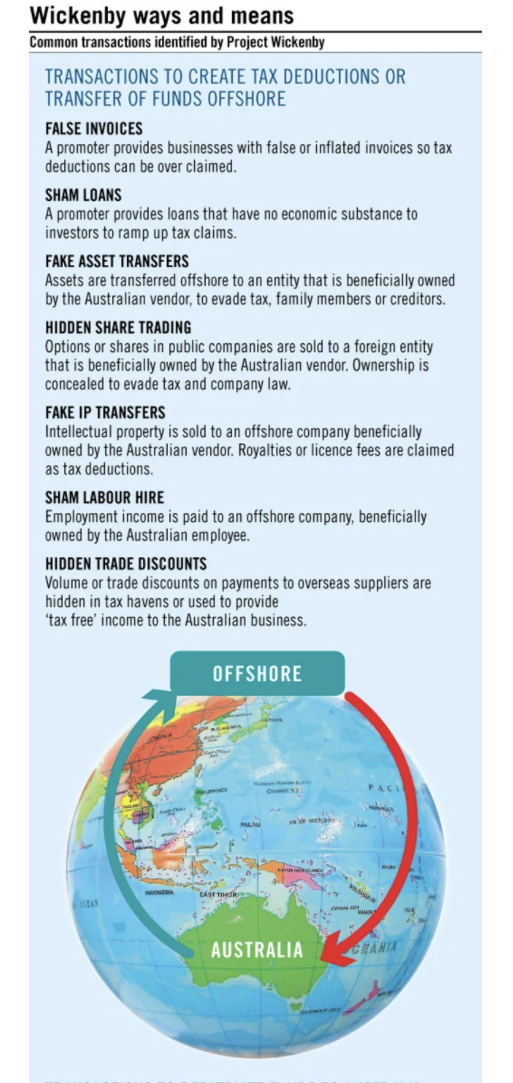


In the six years since, Project Wickenby has split Australians. Who’s the villain here: the scheming promoters, the celebrity tax avoiders, the naive clients or, perhaps, the tax enforcers? The Australian Financial Review has talked to the players in the $430 million Project Wickenby saga, and sifted through court testimony and judgments that mark the trail of a decade-long operation.
“You could just see how easy it was for someone to come here with a laptop, sign some people on and suddenly all the documentation gets done overseas . . . there’s nothing more cancerous – once these things catch on, they become like wildfire," tax commissioner Michael D’Ascenzo recalls. “What really concerned us was there were people coming here peddling these arrangements across a broad cross-section of the community, not just high-wealth individuals," he says.
Wickenby has resulted in 2800 audits, raked in $553 million, sent 18 people to prison while 42 people wait to be tried.
In a three-part series, the Wickenby story reveals how hiding your money overseas became commonplace for a rising class of entrepreneurs; how an Australian Taxation Office operation became the centre of a global attack on tax haven bank accounts; and the attempts to pressure politicians to shut down or limit investigations.
But there are also deep fears about whether hundreds of new cases can ever be brought to trial as time runs out.
The money runs out in June 2013 – along with the legal window that allows Wickenby to operate.
Worse, the taskforce faces two official inquiries while offshore tax schemes are still growing.
The future of this new breed of inter-agency investigation is a major policy question that is the subject of extensive public debate.
Not every taxpayer targeted by Wickenby is guilty of tax crime, and it is wrong to make any assumptions about those charged until their cases are decided by the courts.
But the cases that have been before the courts build a picture of the folly and hubris that produced a train crash.
The Tax Office has identified 200 promoters of the overseas schemes but knows there are many more.
“Every couple of months you get someone coming in from Europe, they’d be involved in private banks, they’re all very smooth but they’re salesmen," one tax adviser told the Financial Review.
The master salesman, one Philip Egglishaw, first came to the attention of Wickenby insiders in 2002, but he’d been selling his wares for almost 20 years undetected for the Strachans accounting firm in Jersey he owned with his brother, Richard.
In a tough field, Egglishaw stood out to his Australian clients as the epitome of the solid English businessman – pinstripes, bowler hat, quietly exuding charm and wealth.
Sydney tax barrister Peter Fraser had known Strachans since the 1980s. “I was familiar with them and Mr Egglishaw," Fraser, a prosecution witness, told the Local Court last year. 
“Mr Egglishaw used to visit Australia regularly, and when he visited he would come to see me when I was a partner at Baker and McKenzie. He acted for clients of mine."
It was “a handful of accounts over 15, 20 years – he provided trustee and accounting services and loans".
Was there ever anything untoward? “Not at all," Fraser testified.
For the senior ranks at the Tax Office – from commissioner Michael Carmody, to the man who would succeed him, Michael D’Ascenzo – and across the organisation, the bottom of the harbour schemes of the late 1970s and early ’80s had been bad enough.
Then the Costigan Royal Commission in 1984 underscored the stunning speed with which tax avoidance schemes had grown and were posing a serious threat to the tax base that runs government.
D’Ascenzo recalls the days after he began as a graduate in the Tax Office’s tax avoidance branch in 1977 chasing the “mass-marketed paper schemes", the most notorious of which were the bottom of the harbour schemes that were “attacking the system on all fronts".
“What that taught me was if you allow widespread disrespect for the tax laws, then you can’t really expect honest citizens to really shoulder that burden," D’Ascenzo says. “It forces honest citizens to rethink their position and it reduces the integrity of the country overall, in terms of its ethics and morals."
“It was almost seen as optional for rich people to pay their tax," he says. “Where respect for the law and the systems is lost, it creates a downward spiral and it took a long time for Australia to get out of that spiral."
In the late 1980s, the Tax Office had switched its attention to the big end of town, which had received little scrutiny so far, launching the large-case audit program, run by then assistant commissioner D’Ascenzo.
In 1988, the ATO raided the Sydney premises of Citibank, seizing hundreds of documents relating to a suspected tax-avoidance scheme. One of the officers was Michael O’Neill, a 23-year-old still finishing his law degree who, a decade later, would join the taskforce formed to investigate tax scheme promoters.
In 1989, one of the key Costigan reforms was realised with the formation of the Australian Transaction Reports and Analysis Centre, AUSTRAC, to monitor money laundering.
By the late 1990s, the tax avoidance focus shifted to mass-marketed tax schemes, many of them based on dubious agricultural projects, films and superannuation benefits. 
They featured many of the hallmarks of tax schemes in the past: the use of overseas vehicles and tax havens, aggressive legal tactics to block the authorities, and promotion by accountants and lawyers.
That episode, which D’Ascenzo says was “disappointing", led to the creation of the serious non-compliance unit, from which Wickenby would later emerge. It is led by deputy commissioner Michael Cranston, who says the difference between Wickenby and the earlier tax schemes is stark.
“The difference with these schemes was the documentation supporting them was offshore," Cranston says. “So if this grew, it’s very difficult for administrators to actually get the information to identify the people involved and also if you needed to go to court – that was a really big concern."
Strachans, through Egglishaw, had entrée everywhere. In Sydney during the ’80s and ’90s he was a trusted contact for the chairman of the Law Council of Australia’s tax committee, Ross Seller. The Jersey businessman was also a contact for Dibbs Barker Gosling senior partner Paul Gregory; in Perth, Greg Calder of Butcher Paull & Calder and tax consultant Greg Dunn; and in Melbourne, lawyer Michael Brereton.
“I’ve got no reason to believe that anything Philip did was illegal," Brereton has told the Financial Review.
Brereton met Egglishaw in 1989 when he was a partner with Barker Gosling. “Any time I had a client going overseas who needed international advice, I’d send them to Philip," Brereton says. “I’ve always found him to be an honest and honourable professional person."
Egglishaw met the former Masters Apprentices guitarist Wheatley when he had fallen on hard times in about March 1994.
Wheatley was working for sports agent International Management Group and staged John Farnham’s hugely successful Talk of the Town tour, although most of his income went to his bankruptcy trustee.
Wheatley says Paul Gregory, who was also a director of IMG, introduced him to Egglishaw, who explained how the $256,410 that was Wheatley’s share of the Farnham tour takings could be funnelled overseas as a “management fee" to a Strachans account for Wheatley. It would be repaid to Wheatley as a loan, on which interest could was charged, though both the loan and the management fee turned out to be shams.
The Tax Office was already chasing Wheatley – he owed $180,000 from an earlier tax bill. Wheatley maintains he was never told the Strachans arrangement was illegal – in fact, he thought the 15 per cent that Strachans and Gregory charged in fees was Swiss withholding tax. He was struggling to pay private school fees for his three children but he maintains the real reason he did the deal was to pay his old tax bill.
“In my naivety, my understanding from a tax point of view was that this was not illegal, as I thought I was paying tax in Switzerland," Wheatley says in his autobiography, Facing the Music. “I was uneasy about it, but at the time I had no alternative."
In April 1994, a month after Farnham’s tour, Egglishaw’s burgeoning links to the entertainment industry led him to Tony Stewart, the Sydney accountant for Paul Hogan and his partner, John Cornell .
The Tax Office had had suspicions about whether part of the Crocodile Dundee royalties were channelled overseas, but had lost a court challenge in the late ’80s.
While the Tax Office didn’t know it, Hogan and Cornell had become Client No. 1 and Client No. 2 in the Strachan files – and in Egglishaw’s Rolodex (according to Crime Commission documents in a Federal Court case before Justice Margaret Stone).
It was so easy. Channelling money overseas as payments for what Wickenby investigators contend were fictitious invoices, sham insurance policies and pretend management fees could be done in a blink.
“All I had to do was approve it," says Wheatley. “The lawyer sent the money off, deducted his secret fee and arranged for the money to come back as a loan."
The Tax Office meanwhile was struggling to keep abreast of the endless new schemes put up by tax promoters, and court battles over whether, when they finally did get hold of documents outlining a tax avoidance scheme, they were prevented from seeing them because of legal privilege claims.
Former Commonwealth Tax Ombudsman Peter Haggstrom put it: “The doctrine of legal professional privilege acts like a `cone of silence’ against the ATO’s attempts to get to the bottom of tax transactions."
Onshore tax schemes were hard enough. But the offshore schemes were almost impossible to detect. And Egglishaw was only one of many travelling salesmen. “Everyone is doing it," an accountant told a Wickenby offender.
And what was the harm?
“You don’t think about it at the time –I don’t think we went in there thinking we were hurting anyone," another convicted Wickenby target says. “We just thought that this is how it was done. We didn’t sit around in a dark room talking about this. We were talking to accountants from reputable firms."
The offshore tax schemes appealed to John Howard’s aspirational Australia: solid, successful citizens whose businesses had suddenly taken off.
One such Sydney executive lost his job but started a rival business under his house with less than $50,000. “In the first six months, we turned over $500,000 and made profit of $40,000; we were expecting $1 million for the full year," he says. “We were panicking about paying our first lease on new grounds, we had no security."
The threat of paying provisional tax was looming. But his partner had heard about an accountant who ran an overseas scheme.
The false invoicing began in a small way. But seven years later, the business was turning over $35 million a year and the tax fraud had become huge.
Today he says he is embarrassed and financially destroyed but, like Wheatley, thinks there was no alternative: “It’s probably something that needed to happen at the time because we were unsure of our financial status. We were unclear, a bit naïve. I guess we were getting something for nothing."
Australian Crime Commission chief John Lawler is dismissive: “What’s happened is these people are sponging off the normal taxpayer. And it’s as simple and easy as that."
What do you do, Lawler asks, “if you’re a dry cleaner and you’re paying $10 million a year tax and your competitor next door is not?"
You either get forced out of business by your competitor, or you join the tax fraud set, say Wickenby investigators.
Another pair of aspirational businessmen, Glenn and Adam Hargraves, were prominent in the Mormon community at Nerang on the Gold Coast hinterland and they had big plans.
By 1999, the Hargraves’ Phone Directories Company (PDC), was doing so well in producing rival telephone directories to Telstra that Adam called his wife’s uncle, accountant John Feddema, to set up a meeting with the Sovereign Capital funding group.
The Sovereign Capital adviser suggested setting up a company in Panama and sending money to a bank in Latvia.
Feddema had another name. He faxed Philip Egglishaw’s business card to the Hargrave brothers together with a letter from Strachans to another client (Feddema had no other involvement).
Egglishaw explained to the Hargraves how it all worked. Ideally they would have a British Virgin Islands company owned by a trust. This would be controlled by a trustee company in Jersey. If it was too expensive, Strachans ran in-house companies.
By September 1999, Strachans had set up Amber Rock Ltd in the British Virgin Islands and the Gabriel Trust in Jersey for Adam Hargraves. Other trusts were set up for Glenn Hargraves and later for British-born lawyer Daniel Stoten when he took a 10 per cent stake in PDC.
“Amber Rock Ltd has been given a London address for cosmetic purposes and is effectively controlled from our office by the provision of directors and company secretary," Egglishaw wrote to Adam. “Again, you will have no relationship with the company in any way and must not be seen to have any control."
Egglishaw had provided unsigned letters of resignation for the “protector" to the trust, who controls the trustees, so that Hargraves and Stoten could seize control at any time.
By October, their new friend Philip was ushering Glenn and Adam and Daniel into the premier suite at the Brisbane Sheraton, where he and his entourage were bivouacking, and passing over the new Standard Chartered gold debit cards they could use to retrieve their overseas funds from ATMs.
The seduction was complete. It was so simple. The Hargraves’ Phone Directories Company had a Chinese firm typeset their directories for about $120,000. Amber Rock would then invoice PDC for 10 times that amount and, just like that, $1 million a year of income miraculously vanished beyond the reach of the tax man.
All of this was off the radar, because by the late 1990s, the ATO was facing a deluge of onshore tax schemes. It wasn’t just that investors didn’t pay tax, but they often claimed large deductions from non-recourse loans that meant they were extracting large sums of money from the tax revenue. They ranged from schemes within the letter of the law, to blatant shams. More worrying, by 1999, some of the tax promoters were moving their schemes offshore.
In June 1999, in addition to the Hargraves, Egglishaw was also talking to Ross Seller at Gadens and accountant Patrick McCarthy, who were getting into whisky. A lot of whisky.
Over 25 months they would raise $24.5 million cash from 190 Australian investors, who would also borrow three times as much by a letter of credit from a company called Chambers Finance. Investors would claim $46.7 million in tax refunds.
Ian Gzell, QC, (now a justice of the Supreme Court of NSW) and barrister Peter Fraser, asked to give an opinion on the whisky scheme in June 2000, concluded that “no factor is present which objectively suggests that the scheme could fall foul of the tests in Part IVA" (the anti-avoidance provisions of the Tax Act). There has been no criticism of the role either lawyer played.
Asked about the Chambers Finance loan, Fraser testified last November, “I knew it was somehow related to Strachans." He didn’t know Chambers Finance, but “if I was lending money to someone I’d certainly go into the background. If someone is lending money to me, I don’t need to go into the background."
According to documents filed with the Local Court in Sydney, Seller and McCarthy had lined up a Scottish distillery to make whisky for them at £2, or $5.15, a litre, but the investment scheme was priced at $30 a litre.
Over the three tax years, Chambers Finance was supposed to provide $73 million of loans, taking the total project to $98.9 million. 
Investors would put down $125,000 cash and take a letter of credit for another $375,000 from Chambers Finance, for 100 hogsheads of whisky. They would report their $500,000 investment as a tax deduction, and claim a tax refund of $242,500 – doubling their money, though subsequent whisky sales would be taxable.
But according to the documents, the loans from Chambers Finance were never drawn down. The promoters paid Speyside Distillery $16.5 million over the three tax years. This left $8 million from the investors’ money for expenses and profits for the promoters.
And there was nothing necessarily wrong with this. They have pleaded not guilty to conspiracy and dishonestly influencing a tax officer.
By 2001 it was clear the 60,000 people involved in the onshore mass-marketed schemes had claimed $4 billion in deductions – which the Tax Office wanted back.
Early that year, the Senate Economics Committee handed down a stinging critique of how schemes had been allowed to grow out of control and called for measures to target the promoters of tax avoidance schemes. There would be changes to tax laws.
In late 2001, Carmody set up a scheme promoters taskforce, managed by O’Neill, now an assistant commissioner but still in his late 30s. O’Neill’s taskforce began by targeting a series of schemes based on films and retirement villages in Melbourne.
In Brisbane in 2002, Christopher Cornell (no relation to John) and Ian Cameron heard about a Gold Coast accountant called Ewan Stoddart who supposedly knew how to reduce tax through offshore loans. Stoddart wasn’t connected with Strachans -- he had business links in Vanuatu that the Tax Office would soon be chasing.
Cornell and Cameron decided they needed someone like Stoddart when they realised that $400,000 of unclaimed supplier rebates for their Giants liquor wholesaling business would leave the business with a huge provisional tax bill and cash-flow problems.
When they fronted Stoddart, they told the Queensland Magistrates Court, he suggested a set of back-dated invoices for the Giants business that whisked $341,000 overseas. Stoddart would keep 20 per cent and send the rest of the money back as an offshore “loan" to Cameron and Cornell, who could then loan it back to Giant.
Their new financial director, Donald Hood, told Cameron and Cornell it was illegal. He showed them the section in the Accountants Manual that spelled out the offence and the penalties. Cornell told him not to worry, Stoddart would never put them in that position.
Melbourne entertainment lawyer Michael Brereton was similarly naïve about the offshore tax scheme he’d become involved with. But Brereton and his production of the musical Jolson were among 30 tax scheme promotions under surveillance. Brereton had raised $3.2 million from high-profile investors together with letters of credit for more than $8 million from a Strachans British Virgin Islands company, Westminster Finance.
The loan meant the investors could claim back as a tax refund more than they had invested, thanks to the loan from Westminster, which could only be paid back out of the show’s profits – and unfortunately the show had flopped.
It wasn’t until O’Neill’s task force was beefed up to 55 tax officers in mid 2002 and Brereton’s marriage to Sian Stokes broke up that things came to a head.
Brereton blamed his ex-wife (though she denies this) for fingering him to the taskforce, which raided his law firm on May 22.
“Sixteen wealthy clients of another promoter visited today claimed $15 million in deductions in 1999 through a theatre scheme," the Tax Office announced.
Brereton later told journalists, “In 2002, you get a raid and that gave them the link to Egglishaw." Brereton himself would emerge unscathed.
Other Egglishaw clients were not doing so well. The Tax Office had disallowed the deductions that Seller and McCarthy’s investors were claiming on the whisky scheme.
On the Gold Coast, the Mormon Hargraves had also suffered a setback. 
One of their staff, Dirk Smibert, had been a director of Phone Directories Company since 1996 and, crucially, a very devout Mormon.
The Hargraves wanted to keep Smibert on staff, and offered him a 4 per cent stake in PDC. But he balked when they explained he would have to take his dividends from Jersey in cash through an ATM.
Adam and Daniel Stoten told Smibert he was “ignorant" and that it was all “completely above board". However, on April 12, 2002, Smibert resigned.
“Admittedly, financial management is not among my talents," he wrote.
But he did not feel comfortable that Stoten had just told him that if he tried to pay tax on his dividends he could jeopardise his fellow shareholders’ tax position. “I do not want to lose what I believe I have earned and am entitled to and indeed what I have relied on, but I am prepared to if it comes to it," he added.
Smibert then went off to head a Mormon mission to New Zealand. In hindsight, the best person to recruit into an offshore tax fraud is probably not a Mormon missionary.
Actor Paul Hogan was also doing a deal that would cause him headaches.
On July 18, 2002, Hogan allegedly had a little windfall when Trelene Investments, the British Virgin Islands company set up for Hogan by Phil de Figueiredo of Egglishaw’s firm Strachans, paid $US5 million to Hogan in a “sham" transaction for the rights to make Crocodile Dundee 4. At least that is what the Australian Crime Commission would claim in a document later obtained by Hogan’s lawyers, who filed it in the Federal Court.
The ACC document says Hogan told US tax authorities he was moving back to live in Australia on July 1, but he told the Tax Office he became a resident on July 26, so he was stateless when Trelene made the payment.
By late 2002, Monaghan and O’Neill at the Tax Office had pulled together enough about Egglishaw and his relationship with Brereton to want to call in help from the newly formed Australian Crime Commission.
By May 2003, they had convinced the new head of the Australian Crime Commission, Alastair Milroy, and the ACC board to open a joint investigation with the ATO into money laundering and tax fraud.
It would begin with Brereton and Egglishaw. It was called Operation Duxford. On Egglishaw’s next trip to Australia, the Crime Commission searched his Sydney hotel room after he booked out on November 4 and found Strachans brochures explaining their tax schemes.
The circle was closing on Egglishaw’s Australian clients, but none of them was aware of this, and the deals continued.
Wheatley says he always believed that Strachans’ fees were Swiss tax. He maintained this belief even when he managed to negotiate the fees down to 11 per cent in 2003 in a deal that diverted $400,000 of his profit from a Kostya Tszyu boxing match to Switzerland. (Dibbs Barker Gosling senior partner Paul Gregory was convicted of conspiracy to defraud the Commonwealth over the Kostya Tszyu profits but was cleared of charges that he assisted Wheatley’s 1994 tax evasion.)
In early 2004, after an Australian government request, Jersey authorities raided Strachans offices in Jersey.
Philip Egglishaw walked out of Customs at Tullamarine airport on the morning of February 14 and turned on his phone, to learn of the Jersey raids from his brother, Richard. Philip headed directly to the presidential suite at Sheraton Towers Southgate, and asked for a shredder.
This is the scene that defines Operation Wickenby and almost a decade of tax investigations, as Crime Commission officer Gail McClure and her team burst into Egglishaw’s suite and seized his laptop that detailed all his Australian clients.
But the action was just beginning. Egglishaw called his brother Richard in Geneva. Strachans then began calling clients.
By that afternoon, Mormon Adam Hargraves and his lawyer Daniel Stoten on the Gold Coast had heard about the raid. They in turn called “Uncle John" Feddema, wanting more information.
The raids had interrupted Egglishaw’s plans to meet his lawyer mate Brereton in Melbourne. But Brereton had other worries as well, after Law Society of Victoria investigator Ronald Hall turned up to audit his law firm’s trust account.
Brereton had drawn $50,000 that belonged to a British Virgin Island company called Westminster Finance that had previously financed Jolson. Hall told Brereton to pay it back, which he did on Tuesday February 17 – then two days later moved it back again marked as expenses, the court later found.
Egglishaw didn’t get to meet Brereton because he was enduring a five-day interrogation at the hands of Tim Sage of the Crime Commission. He appears to have spoken freely before flying out on March 1.
Soon after his return from Australia, Egglishaw accidentally killed his hard drive on the laptop, leaving him with no record of what the Crime Commission held.
The fear of being drawn into the crackdown on Egglishaw was spreading across Australia.
On the Gold Coast, Daniel Stoten was emailing Strachans in Jersey to ask for account balances for all accounts, but got no reply.
By March 24, Stoten was in Geneva to see Egglishaw personally. Egglishaw told Stoten to stop emailing, and to communicate only by telephone. (Strachans provided its top clients with European registered phones that Australian police could not tap.)
Egglishaw also told Stoten he would have to use new Visa cards in the name of someone overseas.
Meanwhile, the Wickenby team was struggling to work through the wealth of material copied from Egglishaw’s laptop. It was the biggest single source of tax intelligence that most of the tax officers had ever seen--and unlike the 1988 Citibank raid, this time they did not have to give the documents back. 
What they read there appalled them, set alarm bells ringing right up to the top of the Tax Office, to Treasury and to the Treasurer’s office. If they took hold, these schemes would go viral and there would be no stopping them.
D’Ascenzo says: “When we saw the laptop and the information that was available there, which was really ‘give me some details and I’ll give you some documentation’ – that really becomes open slather. You really have to say that is not the behaviour you have in Australia."
The head of the federal Director of Public Prosecutions (DPP), Chris Craigie, SC, says: “Wickenby when it surfaced was seen as a very serious threat to the taxation system and something that could cripple the revenue."
Tax barrister Michael Inglis says Wickenby is a far more “real time" reaction to tax crime than we have seen before, including the bottom of the harbour schemes 30 years ago, where only a handful of promoters were prosecuted eight to 10 years after the event.
“Wickenby is a modern response to a modern threat to the integrity of our entire tax system and is utterly different to anything that has gone before it," Inglis says.
Inglis, who has represented Wickenby targets, says the overseas element makes the schemes a systemic risk in the way the mass-marketed rorts a decade ago were not: “I’ve seen arrangements where you have accountants in a tax haven who are the directors, and managers of a tax haven company with millions of dollars in the bank. The company appears to be totally controlled by the accountants but a person in Australia is the only one authorised to use the bank accounts. That’s a threat and I believe they are just nibbling at the problem."
Meanwhile, how to use Egglishaw’s files? The team turned to AUSTRAC to try to trace the cash trails documented in the laptop.
The Australian Crime Commission ramped up nine investigations into clients of adviser Strachans while the Tax Office ran its own investigations into several dozen more. 
The Attorney General’s Department and the DPP would set up requests for more raids in Jersey and Geneva to coincide with Australian search warrants.
None of this was apparent to Egglishaw. The ruckus over the laptop seemed to have subsided. His clients could still access their overseas cash with new credit cards issued by Corner Banca in Switzerland in other people’s names, so that there was no paper trail for the Tax Office to follow.
Egglishaw’s laptop had lists of credit card records with partially obscured names. On December 3, 2003, under the name “Jo Co" there were three withdrawals from the Brunswick Hotel, which the Tax Office would later claim in Federal Court were made by John Cornell, whose Hizan Holdings Pty Ltd owned the hotel.
For Strachans’ clients, it was business as usual – until the morning it all fell apart.
From 7am east-coast time on June 9, 2005, 285 federal police and tax officers executed 48 search warrants and the Tax Office executed 37 Section 263 access visits over two days to law firms, accountants and clients from Brisbane to Perth.
In Perth, when Glenn Wheatley put down the phone from his wife Gaynor, he phoned Paul Gregory. The senior corporate lawyer told Wheatley not to talk on the phone because it was probably bugged, and to get a lawyer.
On the Gold Coast, Daniel Stoten returned from the gym to find policemen searching his home as his wife made their children breakfast.
Stoten called Glenn Hargraves to ask the $5 million question: “Did they get the card?"
No, the Banca Corner Visa debit card was safe, Glenn told him.
“Good," said Stoten, and rang off to call Adam Hargraves. The police had not found Adam’s card either. “They really haven’t got nothin’ there then," Stoten told Adam.
The calls became a blur. Adam to Daniel again, discussing what the police had seized, and making plans to meet at Glenn’s house.
Another call. This time it was Philip Egglishaw on the line to Stoten, quietly reassuring.
Egglishaw: “They’re fishing now in Australia, because they can’t get anything from my area."
Stoten: “They’ll get bits and pieces from us, there’s no doubt. But they won’t get much."
Stoten was more worried by the time he called “Uncle John" Feddema.
Feddema: “Um, you wouldn’t have anything at home though would you?"
Stoten: “Um, I’ve just, the only, nothing at home, the only thing they got was they got the [mumbles] – the fucking card."
The Federal Police had found a Premium Intercard Visa Card in the name of Donald Ward in Stoten’s wallet in his LandCruiser.
In Adam Hargraves’s wallet they found a Visa card in the name of Gry Stenson.
They missed a third card, in the name of David Winterbottom, that Glenn’s wife Joanna Hargraves had in her handbag. Glenn told investigators he destroyed it.
At other locations, documents went down the toilet or were tossed out windows, as they were by the Hargraves’ office manager, as the mass raids created great panic.
In Sydney, tax lawyer Geoff Stein had settled in at 9am to conduct a job interview at his firm Brown Wright Stein. Then the phone started ringing. And ringing. 
The job interview took two and a half hours as he was continually interrupted by panicking clients. The calls were still coming in at 9.30 that night, when Stein decided to go to a client whose business premises were still being searched.
Senior Wickenby staff were on tenterhooks as the secret raids rolled out. A casual query to the Federal Police by Financial Review journalist Angus Grigg about rumours a Perth stockbroker had been raided had Crime Commission chief Alastair Milroy on the phone within minutes, asking Grigg not to break the story.
The next day, as further raids continued, the PDC office manager on the Gold Coast told Daniel Stoten that she had looked around outside the Niecon Plaza building and had found the accounts book she had thrown out during the search. Stoten told her to destroy the book. He told another employee to wipe data: “Anything remotely connected with any of those names, get rid of [it]."
Stoten fell to worrying. He had $40,000 cash in a Commonwealth Bank of Australia deposit box. How to get it out? He didn’t want to be identified so, remarkably, he asked his brother to get him a disguise. He went to the bank in costume, only to lose his nerve when he saw police waiting outside the bank.
Stoten and his wife Katherine spoke on the phone – and they were desperate.
Daniel: “The whole point of that was because we thought that’s the way to do it so it’s legal, and this is how it ends up, it’s just really, it absolutely rocks my mind."
Katherine: “But how, how do we explain the credit card though? Like I mean, if they say to me have I seen it, yes I’ve seen the credit card, and I mean it’s in someone else’s fricken’ name, I mean how fraudulent is that?"
A jury would later convict Stoten and Adam Hargaves but find Glenn not guilty because he stepped down from the business before Smibert told them it was fraud.
Meanwhile the Tax Office, the Crime Commission, the Federal Police, AUSTRAC and the Director of Public Prosecutions were overwhelmed by a mountain of new material from the June raids. 
“Wickenby was quite an extreme concern for the tax authorities because of the marketability, the ease of selling these schemes, and the ability to hide the evidence. Because of that we really needed the agencies to come together to deal with it," the ATO’s Cranston says. 
D’Ascenzo says the “turning point was the ability to provide sufficient information to the government of the day to persuade them this was a sufficient risk and to fund it as a project".
But at least some of the targets of the June 2005 raids seemed nonchalant about the fuss.
Yes, Glenn Wheatley admitted, he had been raided but it was all very straightforward and he was certain nothing would come of it.
“As far as I can tell, it’s just routine and nothing else," he said. “I’m surprised this hasn’t happened earlier in my life."
News of the raids didn’t seem to faze others, such as Michael Milne, much either.
Milne had cashed out a large parcel of shares he had transferred overseas to five corporate trusts called stichtings that Sydney lawyer Anne Harley had set up for him in the Dutch Antilles.
With the shares sold by mid-2005 just before the raids, it was time to spend.
There was $270,000 for a yacht he named Black Snake, $5 million or so on houses, $71,534 for the Bentley, and $390,000 for a Jeffrey Smart painting, The New School, which looked rather fetching in his new lounge room, or so the Federal Police would comment three years later when they raided Milne’s home. He was jailed for eight years for money laundering.
Like Milne, insurance broker Charles Pratten had bought a few treats with the insurance premiums he shipped off to his company in Vanuatu, according to prosecution claims in court.
Pratten had school fees to pay, but through a web of companies he still managed to pick up a 45-foot game fishing boat, Los Lobos, a farm at Wards River and a Robinson R44 helicopter (there was some confusion as to whether he owned it personally or, as he suggested, it was part of his company’s air wing).
The Wickenby insiders were heading to warmer climes as well.
One investigation began when tax officers auditing an Australian accounting firm noticed that many of the clients were paying invoices to Vanuatu.
The Federal Police ran four separate operations investigating suspected cash transfers to and from the Vanuatu – although it’s important to note there were plenty of legitimate investments in the island.
These investigations would not come to light until 2008. As always, Project Wickenby operated in secret. But there would be a secret running behind all the other secrets – a side of the Wickenby investigation that has never been acknowledged.
It began with two strange emails. One went to British Revenue & Customs in late 2005, but they were too slow to respond. So the anonymous emailer wrote to the German secret service, the BND, in January 2006.
The emailer offered to provide detailed records for €3.5 billion in investments held in a tax haven. The writer was not seeking payment for this information, he said, but it seemed “deeply unfair that multimillionaires could continue to amass their fortunes without paying taxes".
However, he wanted far more than that. He wanted to live in Australia.
Fiona Buffini helps to drive the Financial Review's news agenda and oversees how we deliver the news on afr.com and via our other digital platforms. She is a former news editor and national reporter. Email Fiona at fbuffini@afr.com
Hannah Low writes on Business specialising in Legal. Based in our Sydney newsroom, Hannah is a Walkley Award winner and Legal editor. Connect with Hannah on Twitter.


Sunday, May 01, 2011


It's 2011. Volatility is the new normal.

What’s the Difference: Early Adopters vs. Laggards Your greatest danger is letting the urgent things crowd out the important

The Learning Decade Swimming outside the flags
Four hundred years ago , British philosopher Francis Bacon declared that “Knowledge is Power.” And, until recently, many corporate leaders would have wholeheartedly agreed with him.

But, today, as we struggle to cope with an uncertain economy, complex globalization, and unprecedented technological transformation, executives on just about every continent increasingly believe that “Knowledge is Survival.” Companies around the world responded to the Great Recession by cutting and controlling costs to reap new eficiencies. The next challenge is growing the global economy; and corporate and government leaders now realize that learning-driven innovation is the most promising way to generate much-needed top-line revenue and the jobs that result.
Indeed, learning has gained new prominence as a critical lever for performance. And it has seeded new strategies that are creating competitive advantage and diferentiation in boardrooms, conference rooms and work environments all over the world. To be sure, not every company is a learning company; but more and more organizations recognize that learning can help solve the most vexing economic and #nancial problems of the day. As a result, we predict that the years leading up to 2020 will be known as “The Learning Decade.”


• Critical lever for performance [The Wall St. Journal suggests that more kids are their own boss in this tough economic climate. At a time when it’s hard for high school students to find the typical jobs that see them through the summer, many are opening up shop, commercializing the proverbial lemonade stand and taking it to new levels... Who’s the Boss? proverbial lemonade stand ; You could be forgiven for thinking that the cold Spring of 2011, with its cutbacks, closures, price hikes and app-frenzy is not the best of all possible times to launch a new magazine, writes John L. Walters. Especially a beautifully printed quarterly targeted at affluent, stylish city-dwellers. Yet here comes Port, an independently financed start-up spearheaded by two art directors and an editor, brimming with confidence, big pictures and long articles. Port]
• · Success is coming down to how comfortable we are with endings, Henry Cloud in Necessary Endings; Crime stories are a ghoulishly satisfying reminder that although murder is possible, it hasn’t yet happened to you.. Murder most entertaining.
• · · In 1896, the Cambridge don Solomon Schechter climbed behind a wall in a Cairo synagogue and discovered the detritus of an entire civilization ; Over-stressed parents, Bryan Caplan has some advice: Stop trying so hard. Have more kids Pay less attention to them
• · · · Bold Innovation Bold: How to Be Brave in Business and Win ; The least Indian of Indian leaders”: V.S. Naipaul's astute assessment of Gandhi, whose social conscience was forged reading Tolstoy in South Africa..; The best ideas prevail. Well, maybe not. We’re hard-wired to reject evidence and views that contradict our beliefs – these days, more than ever
• · · · · For an economist like Peter Orszag, two career paths beckon: public intellectual or Wall Street mandarin; Stiglitzism or Rubinism ; Biblionecrophilia: The conversation about print’s demise has been consumed by nostalgia. As if Amazon will forgo e-profits after recalling the tactile thrill of curling up with a musty paperback..
• · · · · · Selfless behavior has long baffled evolutionary theorists. But E.O. Wilson now claims that he can explain altruism. The response has not been kind... ; The Bible brims with contradictions, says Timothy Beal, but no matter: The Good Book is best read as a catalog of questions, not answers

Thursday, April 28, 2011


In the weeks since the [Inspector General]’s flawed and narrow vision of our diplomatic mission, people of good will in the middle ranks of our Department have seen it as their calling to strictly enforce it. As a consequence, my voice has been prevented from speaking; my pen has been enjoined from writing; and my actions have been confined to the ministerial. You deserve better, but until these rigid, and rigidly narrow, perspectives are overcome, you and the President are being deprived of the intelligent insight of much of your Embassy’s work.
– Douglas Kmiec, noted constitutional law scholar and former Catholic University law school dean, tendering his resignation as U.S. ambassador to Malta to Secretary of State Hillary Clinton. Above the law

Outcry over spy phones Start Another Fire and Watch It Slowly Die: The Aftermath of Regime Change
Adam Curtis , a documentary filmmaker, traces a loose history of the modern concept of humanitarian intervention in the West and its philosophical underpinnings - punctuated, unsurprisingly, with several compelling documentary film clips.


While historians may quibble with certain aspects of his rendition, there was one passage that stood out:
The movement had begun back in Biafra because a group of young idealists wanted to escape from the old corrupt power politics. To do this they had simplified the world into a moral struggle between good and evil.
They believed that if they could destroy the evil - by liberating victims from oppression by despots - then what would result would be, automatically, good. But the problem with this simple view was that it meant they had no critical framework by which to judge the "victims" they were helping. And the Baghdad bombing made it clear that some of the victims were very bad indeed - and that the humanitarians' actions might actually have helped unleash another kind of evil.


• Might actually have helped unleash another kind of evil [ ; ; ]
• · Amid rising scrutiny of their practices, Google Inc. defended the way it collects location data from Android phones, while Apple Inc. remained silent for a third day Google Defends Way It Gathers Phone Data; I do not care if Apple and Google know where I am. The revelation that Apple's storing location data and keeping it for a year or more on my iPhone and my computer has shocked many, but not me. Hey, everybody, this is exactly where I am and what I'm doing right now Location Is Not a Four Letter Word ; Google (GOOG) Android phones also collect location information, although according to a report in github, those files are regularly pruned, leaving only the most recent data. Track your own iPhone; How Much Should You Freak Out About Apple and Google Tracking Your Location ; Google Links
• · · 14 favourite applications ; Mobile Madness Global mobile traffic nearly tripled for the third year in a row in 2010 ; This work should serve as the final salvo in the long battle between those who are still in denial regard ing KGB espionage in America in the 1930s and 40s and those who assert that this story must be told Spies: The Rise and Fall of the KGB in America
• · · · Above the Law – This blog refers to itself as a "legal tabloid" and offers amusing commentary on the latest in law.
Law blogs, also known as blawgs, are plentiful these days. In fact, there are probably thousands to choose from and more appear each week. For that reason, it may be difficult for you to narrow down which ones are worth a regular read. Whether you are a lawyer, law student, or merely interested in the subject, we’ve attempted to cut through the chaff and provide you with what we regard as the top 100 law and lawyer blogs listed below. It was very difficult to choose only 100 blogs from the myriad of successful law blogs. In an effort to remain fair, you will find a variety of subjects covered with the following blogs. Not only are high-profile general law blogs included, niche blawgs are also offered for your consideration. Since it would be impossible to rank them according to importance, they are categorized according to subject and then alphabetized. According to our research, here are what we consider to be the top 100 law and lawyer blogs ;
Martin Luther King, Jr., was assassinated on April 4, 1968. I was five years and three days old. One can kill a person, but cannot kill an idea. Our present world is at a critical crossroads where many people stick their necks out for social justice and other social good (unfortunately including those causing severe social damage while seeking well-intentioned goals -- MADD comes to mind, for instance ), while too many others look out solely for number one, and while many others tread sometimes inconsistent paths somewhere in between. Everyone can improve. Nobody stays the same, just as a river constantly changes; the water molecule that is in front of us in the river at this moment will be miles away later today, and the riverbanks will continually be changed by the river. Few people are a**holes, even though most people sometimes or more often than that act like a**holes Compassion and kindness are a two-way-street ; It has been more than six months since I was forcibly removed from my old job as a deputy prosecutor. Since then, times have been extremely tough. Unemployment is not a way to survive; it is a way to suffer. I can only barely make ends meet at this point, and I grow ever more desperate each day. Everyone says that it is not my fault, and that I should blame the economy for my inability to find gainful employment. But I have no desire for excuses. I want to work again; I want to help people again. All that said, I feel it is time for me to make my own plea for help Facing Reality
• · · · · Home value chart updated 1890-2011
Case Shiller 100 Year Chart (2011 Update), By Barry Ritholtz - April 13, 2011: "In 2006, just as the Housing market was peaking, the NYT ran this graphic of the 100-year Case Shiller chart. It showed how radically overvalued Housing had become. Two years later, TBP [the Big Picture] reader Steve Barry updated that graphic, including the projected Home Price mean reversion ; A land value tax will solve the problems of escalating house prices. Property supply magic ; Kevin received a warm thank-you from Yvonne Adele, the inventor of a global overnight brainstorming service called Ideas While You Sleep While You Were Sleeping
• · · · · · The best tips for cleaning and organizing your home including garages, closets, kitchens, bathrooms, This Too Shall Pass ; at Real Simple

Wednesday, April 27, 2011


How does that spark of creativity find its way to the canvas, the page, the dinner plate, or the movie screen? Inside the messy, maddening, and mysterious process of creating something new Great art begins with an idea

Monday, April 25, 2011


Why read? In the end, the answer to the question is as complex and compelling as "why live?"

Speaking as a former soldier and sole survivor, I know too well that stolen waters are sweet, and bread eaten in secret is pleasant. But reading words inside the samizdat wikileaks at the Sydney Writers’ Festival is pure ecstasy … The Festival will look at power in its many incarnations … the power of the writer to shape the world with words, the awesome forces of nature under pressure, the power of the individual to effect global change and the constantly shifting nature of power itself: who’s got it, and why, and how technology is forcing a shift Poets like Jozef Imrich are now surfacing in bars, cafés, gypsy caravan tours, national events and even recognized within the Sydney Writers' Festival

The world might have forgotten the name of Mohamed Bouazizi. But when the history of the revolutions sweeping the Arab world is written, the 26-year-old Tunisian vegetable seller will be remembered as the rebel who lit the fuse that destroyed the Middle East’s old autocratic order. Today, as uprisings erupt across a region long resistant to change, every young Arab has become a Bouazizi, the frustrated youth who set himself on fire two months ago in a tragic protest against the ills afflicting Arab society, from corruption to unemployment, to a denial of dignity. Making history in the street: The Arab Youth - Mohamed Bouazizi Set himself on fire

In 1968, Czechoslovak people welcome the changes of the glorious Prague Spring and dream of everlasting freedom. But, the Mittle European history has a way of doubling back on its natives. One summer night the country is invaded by the Russian. In the winter of 1969 a young man called Jan Palach burns himself to death in front of the statue of St Vaclac in Wenceslaw Square. Making history in the street: The Bohemian Youth - Jan Palach burns himself to death in front of the statue

A high priest at the altar of fiction Divulging uncomfortable details: pushing the power of words
The war hero who inspired James Bond (and had a bizarre sex pact with Ava Gardner)

Brussels had just been liberated. In a bedroom on the second floor of a sumptuous mansion, Geoffrey Gordon-Creed, a handsome major in the British Army, and a pretty young Belgian girl were engaged in enthusiastic sexual athletics. Suddenly, there was a loud rapping on the door. It was the girl’s father, a rich Belgian baron, suspicious that his daughter might have company and determined to protect her honour.


Unless It Moves the Human Heart: The Craft and Art of Writing, “and wonder if, in some way, their reckless enthusiasm for art, conceived and nurtured in an increasingly money-driven age, represents their unconscious protest against the age... They turn to the power of their powerlessness, not unlike Vaclav Havel, Milan Kundera, [and] Ludvík Vaculík.” Havel, Kundera, and Vaculik lived in Soviet Eastern Europe, where everyone was expected to sacrifice their own individual desires for the greater good — a sea of faceless workers with no personal right to speak. They put themselves at great risk, facing jail and exile, to break through the anonymity. They led revolutions and then nations. They faced their time’s great evil with humor and an unwavering stare, and through that created works of great beauty.
• Read an eye-opening memoir All That Is Bitter and Sweet [A brutally frank tale of addiction This Is Gonna Hurt ; Since Shakespeare wrote so many years ago, scholars had had all this time to get it right, hadn't they All memoirs tell their own version of the truth; There's often little to distinguish victim and perpetrator in Africa's new hearts of darkness - Dancing in the Glory of Monsters The Triumph of Fear - Tales from between the sticks]
• · Growing up female is hard work; you have to be attractive, independent, smart, and funny, but not too challenging if you want to get a date. I am like a glass left on the bar, empty, a lipstick stain on the lip, a melted ice cube at the bottom ‘Bossypants’ and Other New Memoirs by Literary Ladies ; Make no bones about it Love and revolution
• · · Under-reported by the media, mercy killings by fathers and male siblings of Muslim women who are joining the movement are increasing Not Easily Washed Away ; Memoirs are often a literary bore. The world cared little about the hum-drum life of most folks, despite the writer’s conviction that the world really does care. Book serves as memoir of city ;While Charlie Sheen implodes in front of the world’s eyes, he could take comfort in the salutary tale of his old Brat Pack boozing buddy Rob Lowe Still in Hollywood, Lady Blue Eyes (Hutchinson) has Barbara Sinatra (nee Marx) divulging memories of her life; Publishing isn't dead. Smart publishing, well, that's a different story. The skeleton of the story burned itself into my brain, even if the details didn't. A Sea of Words: Drowning in Cold River
• · · · One of my favorite topics in novels and memoirs alike is the concept of fear. I always think of my writing as a relationship story. I hope they also tug at the emotions ; Lord, you are most irritating - self-serving memoirs Madness for “Memoirs In March”; >; By my count my mother has written three memoirs, six autobiographical novels and four memoirish explorations, and so I think it's safe to say that the Sharing Her Secrets
• · · · · He tells it like it was, living with a father who was a “mean drunk,” Schrader: Memoirs from growing up in county ;Ours is an era of scrupulously examined lives, which is another way of saying that ours also is an age of too many memoirs, often by writers with no public face or career Growing up in her father's shadow ; Julian Assange is a very dangerous man to those who want to suppress the truth," says Pilger. Assange's habit of spilling very big beans to millions Julian Assange: the most dangerous man in the world
• · · · · · Tragic Life Stories - ‎Writing in his memoirs -A rarefied group of leading literati convened recently to evaluate the writing genius of Barack Obama. They came to a surprising conclusion: Barack Obama may in fact be a greater writer than William Shakespeare.m It's important to note that none of these folks, absolutely none of them, are addled-brained liberal lunatics. Obama a Greater Writer than Shakespeare ; Hitch-22, of the numerous perils that he has faced as a reporter around the globe in places as various as Afghanistan, Northern Ireland and Beirut, Christopher Hitchens reflects that a little danger or discomfort can be a salutary thing: ''I still make sure to go, at least once every year, to a country where things cannot be taken for granted, and where there is either too much law and order or too little.'' Don't pray for me‎ ; A survivor's story is about man's desire for freedom during a time when none existed. Pray For Media Dragon

Friday, April 22, 2011


Once or twice in a century, Easter and Anzac Day share the same date – it last happened in 1943 and will occur again in 2038. But curiously, in the way we calculate Easter it cannot fall after Anzac Day, it must always be a forerunner, perhaps the template on which great tales of sacrifice and renewal are patterned.
The themes that run through both stories are rich and deep; of sacrifice, the death of innocence, companionship, compassion, =And the birth of a new reality
Ach Have an ethical Easter

When her daughter died, Edith Piaf slept with a man to pay for the burial. The melancholy grit of Piaf’s voice was hard-earned. From her father she learned an entertainer's sense of timing, techniques for tugging on the audience's heartstrings, and the sort of patter likely to produce a good take No Regrets

Heartstrings Morals vary dramatically across time and place
Each time I write something I promise myself I'll never do it again. The fallout goes on for months. Increasingly, like of late, it turns dangerous

In the wake of sedition threats by the Indian government, Arundhati Roy describes the stupidest question she gets asked, the cuss-word that made her respect the power of language, and the limits of preaching nonviolence.


• The Un-Victim - I'm impatient to die [Sure, the future of publishing looks grim. But not entirely. A new literary culture is taking root in the digital world Do you love books?; Long-form journalism is the only homegrown American literary form ]
• · Are you forgetting how to remember? Here’s a tip: Try picturing Lady Gaga swimming in a giant tub of cottage cheese The lost art of total recall
Are you forgetting how to remember? ; In The Fugitive, Stanley Fish sees a story about liberalism's central tension: Society and responsibility on one side, absolute freedom on the other Save it for HBO
• · · Biological and cyberwars are stealth businesses. Fingerprints are rare; the perpetrators often unknown. Does retaliation have a future? The New Virology; We have neither money nor power, but cinema can make our voices heard - Sexual economics 101: Men represent demand, and women supply. It's a catchy formula, and perhaps obvious, but it little resembles reality The Meet Market
• · · · The current blueprint for political revolution blends Gandhi, Monty Python, and corporate-style marketing savvy... Revolution U
; Researchers in Siberia have managed to breed foxes as tame as dogs. It's a feat that might unlock the genetics of violent behaviour Only a handful of wild animal species have been successfully bred to get along with humans. The reason, scientists say, is found in their genes.
• · · · · The Internet isn't making you stupid or unhappy or less productive. But it might be subverting your creativity Smarter, Happier, More Productive; A senior traditional owner, Yvonne Margarula, says her Mirarr people are "deeply saddened" that for more than 30 years uranium that should never have been disturbed on their land at the Ranger mine in the Northern Territory has been exported to Japan to be used by nuclear power companies, including at the stricken Fukushima plant, which was heavily damaged by the tsunami last month and has been leaking radiation. a sacred dangerous power
• · · · · · Landshare, the process by which land owners allow fellow city dwellers to use their land without charge, seems to be catching on. It began about five years ago in north America and Europe Breaking ground;shift towards academic qualifications, and crafts skills have become devalued. The sorcerer apprentices

Thursday, April 21, 2011


We're all Keynesians now Soros: U.S. Dollar No Longer World Reserve Currency

What's especially bizarre about this premise is the notion that writer's block can be overcome by an increase in intelligence. (More plausibly, Eddie, once he gets really, really smart, decides to bail on writing books entirely.) It would be hard to find a blocked writer who thought that brains were exactly what he or she lacked. In her fascinating 2004 book, "The Midnight Disease: The Drive to Write, Writer's Block, and the Creative Brain," neurologist Alice Weaver Flaherty explains that the impulse to create is rooted in the limbic brain, the seat of instinct, not in the cerebral cortex, which performs the analytical activities enhanced by Eddie's pills. Most cases of writer's block are not, however, the result of a biochemical imbalance

At first blush An annotated history of that most poetic instruction, “last name, first”- Dragon, Media
Neuroscience revolves around one big idea: You don’t control most of what you do, think, and feel. Your brain calls the shots. Therein lie the seeds of a legal revolution


The first lesson we learn from studying our own circuitry is shocking: most of what we do and think and feel is not under our conscious control. The vast jungles of neurons operate their own programs. The conscious you – the I that flickers to life when you wake up in the morning – is the smallest bit of what’s transpiring in your brain. Although we are dependent on the functioning of the brain for our inner lives, it runs its own show. Your consciousness is like a tiny stowaway on a transatlantic steamship, taking credit for the journey without acknowledging the massive engineering underfoot.


• Much of what many of us know about science, politics and history of the region comes from Cold River [It’s official: we’ve found our new favorite blog. Bill Ryan, a New York based book lover, is collecting insults from his literary heroes. It all started around six years ago at a book signing at the excellent BookCourt, when on a whim, Ryan asked Maggie Pouncey to inscribe his book with an insult instead of a dedication. Now, in his wonderfully entertaining blog, Insulted By Authors, Ryan documents his adventures getting insulted by – or not getting insulted by, as the case may be – his favorite authors, and displays the creatively rude missives for our enjoyment. How to Get Insulted by Authors; BookCourt - We're all Keynesians now]
• · Well, a preternaturally self-assured scientist like Nicholas Humphrey can try Can science explain the soul? ; No bright line necessarily marks the moment when a person becomes a corpse. So how dead is dead enough to become an organ donor? Dead; Meghan O'Rourke wants to tell the story of her mother's death - to make sense of what happened, and perhaps change the ending Why We Write About Grief
• · · While you await the return of prosperity, consider a future in which the rules of capitalism are undermined by a parade of disasters. How worried should you be? parade of disasters; Some cultures endorse cannibalism, decapitation, infanticide. Morality, says Jesse Prinz, is relative. But objectivists shouldn’t despair: Self-destructive values rarely last. Conditions
• · · · New York in the 1970s was known for crime and drugs – and dance, which was for a terpsichorean moment the most vital performing art in America Dancing the Body Electric; Who owns yoga? Now that it’s a multibillion-dollar industry, everyone wants a piece of the action. But yoga’s history is a palimpsest. Malchkeon owns it - Yoga began before 2500 BC- Sikhs rock
• · · · · Happiness is not a right, it’s a duty: We owe it to ourselves. But the burden of obligatory well-being has transformed the pursuit into a source of unhappiness... Jozef Imrich is Condemned to Joy ; "We have a lot of so-called crap," Gildas Illien admits. No surprise there: He's spent the past five years archiving the Internet.. Media Dragon: A Memory of Webs Past
• · · · · · Hamada Ben Amor was an unknown Tunisian rapper. Then he uploaded a furious song to Facebook and helped start a revolution.. From fear to fury: how the Arab world found its voice ; If Ronald Dworkin were a hotel he would be the Savoy, but a Savoy open to all, with guests spilling into every room, talking, arguing, laughing Justice for Hedgehogs by Ronald Dworkin

Sunday, April 17, 2011


Life is no brief candle to me. It is a sort of splendid torch which I have got a hold of for the moment, and I want to make it burn as brightly as possible before handing it on to future generations...
-George Bernard Shaw

I like to see that they're speaking like an actual human being -- a lot of bloggers are afraid to be authentic because they don't want to get blacklisted by the places they want to cover. Fearlessness is one of my favorite qualities in a writer. Gabbie Take Note: How to make travel editors like your blog

It's easy to get the impression that blogging is lonely work. 'A Tunisian Girl' talks about blogging under repressive regimes

First there's the Czech President, Vaclas, Klaus, pocketing a pen in Chili not Mexico City Make no mistake: Smuggler, Forger, Writer, Spy
Czech President Vaclav Klaus may be in the middle of a government crisis, but he's bringing the laughs thanks to a video that's become a YouTube hit.

Watch as he grabs a pen and nonchalantly puts it in his pocket.


•All I have to say, it is not a pen but just a stylus Spiriting away a pen [ Generations, Mobile, Seniors - Generations and their gadgets ; Search User Interfaces by Marti A. Hearst [the author, with permission of Cambridge University Press, has placed the full text online free of charge. See the terms of service] This book focuses on the human users of search engines and the tool they use to interact with them: the search user interface; And with thousands of blogs and so many lawyers online, legal ethics experts say that collisions between the freewheeling ways of the Internet and the tight boundaries of legal discourse are inevitable — whether they result in damaged careers or simply raise eyebrows A Legal Battle: Online Attitude vs. Rules of the Bar ]
• · Use a catchy title. Make the title unique, consider using questions and lists 15 Blogging Best Practices ; The web, as we know, is a great place to market your business — but only if people can find you. Success in online marketing is contingent upon people being able to locate your web presence.
• · · For Andrew Sullivan, M.P.A. ’86, Ph.D. ’90, the editor of a blog called TheDish.com, the weekend is a time for rest, and having teed up on Friday afternoon a half-dozen evergreen posts for Saturday, he had turned off his communication devices and was sleeping in. World's Best Blogger? ;Are you voracious for video, but not fascinated by photos? Bonkers for blogs, but not titillated by Tweets? Fanatical about Facebook, but not emotional about email? You're not alone! From One Comes Many‎ Just as in offline politics, the well-off and well-educated are especially likely to participate in online activities that mirror offline forms of engagement. But there are hints that social media may alter this pattern ‎The Internet and Civic Engagement - PDF
• · · · "Librarians, information specialists, knowledge managers or whatever title a librarian might have -- their skills are in high demand. And, though you might not know it, they are everywhere...At a time where anyone can Google just about anything, librarians don't just find information, they find the correct information -- and fast. The American Library Association reports reference librarians in the nation's public and academic libraries answered nearly 5.7 million questions each week in 2010." [via the awesome librarian Kit Harahan] Librarians: Masters of the info universe ; Users increasingly rely on individual pages listed by search engines instead of finding better ways to tackle problems. Although some analysts questioned the finding of search dominance, it's a user behavior that gets stronger every year. Incompetent Research Skills Curb Users' Problem Solving
• · · · · Famous poet's writings as a Federal employee shed new light on his life and work: The National Archives today announced the identification of nearly 3,000 Walt Whitman documents written during his service as a Federal government employee. This trove of information--conclusively identified as Whitman's papers for the first time by University of Nebraska-Lincoln (UNL) scholar Kenneth Price--sheds light on the legendary poet's post-war thinking, as well as Whitman's published reflections on the state of the nation that soon followed. Price discusses the significance of this discovery in the National Archives Inside the Vaults video short Walt Whitman ; Vaults video short
• · · · · · The Net, smartphones, and other technologies have added to the way people can engage with so much to local communities and wider communities of interest How Libraries Add Value to Communities (Video & Slides) ; REGARDLESS OF FRONTIERS: The International Right to Freedom of Expression in the Digital Age

Friday, April 15, 2011


In uncertainty I am certain that underneath their topmost layers of frailty men want to be good and want to be loved. Indeed most of their vices are attempted short cuts to love
-John Steinbeck, East of Eden

Proust Questionnaire From time to time I get spotted in public, occasionally with unpredictable results. Too much information

Topics for the post mortem on the poll and elsewhere Cheaters Win
They're the hardest words in the world to say: I Love You. Especially to Bankers and Pollies …

There could be no honor in a sure success, but much might be wrested from a sure defeat.
-T.E. Lawrence, Revolt in the Desert
The penalty of success is to be bored by people who used to snub you.
-Nancy Astor (quoted in Reno Evening Gazette, May 4, 1964)


Clever schemes to make bankers earn their bonuses look good on paper, but economics proves they won't work."


IF YOU feel a sense of injustice over bonuses paid to the bankers who all but collapsed the global economy in 2008, look away now. Wall Street is about to pay out around $20 billion in bonuses, barely changed from what it paid in the boom years. Why can't regulators insist that firms pay bonuses based on real long-term profits, rather than rewarding them for reckless short-term gambling?


• Bankers are grinners[ Pathological sickness grips heart of Labor's NSW Right; Curing the NSW disease]
• · We need the spirit of Cavafy today John Azarias; Bob Carr; Gabbie has caught up with the blasts from the past in the Us links to princeston; For the early December training session, four racers arrived. There was Aidan Harding, 30, a mountain biker from Princes Risborough, England. Despite his lack of experience on snow, Harding was considered a serious racing prospect. There was George Azarias, a young Morgan Stanley banker from New York. A practiced hiker, Azarias had little cycling experience.Eleni ; george; George
• · · Labor lost in its first 10 years when Bob Carr neglected Sydney's transport links in favour of announcing national parks. It was Carr asleep at the wheel ; ON Tuesday night Paul Keating put in a memorable performance on ABC1's 7.30. In the course of a swingeing attack on NSW Labor, including Opposition Leader John Robertson and the Sussex Street machine men, he dismissed their chief spin-merchant, Bruce Hawker, for his "sicko populism". Keating tells it like it is for NSW Labor ;CHRISTOPHER Pearson's rather shrill commentary on both Bob Carr and me (Focus, April 2-3) really does deserve a reply. Hawker
• · · · Glen was with me on my first-ever visit to Colombia where I presented to Expomarketing, and announced the launch of Saatchi & Saatchi Colombia. Cool Colombia; Nothing is Impossible
• · · · · NSW Labor had spent almost all it's social capital, and the only thing left was change. Life of the Party;
In the next Queensland election independents may be at risk, as they were in New South Wales The lessons of Port Macquarie; Labor smeared NSW Greens candidate Fiona Byrne for instituting a policy that they had also supported. Smear campaign against Greens in Marrickville
• · · · · · ASIC LAUNCHES NEW MONEYSMART WEBSITE - COVERS ADVICE, TAX AND MORE ASIC's new Getting advice booklet ; It's time for negative gearing of investment housing as a tax deduction to go. A tax system that penalizes working & saving, and rewards borrowing & speculating

Wednesday, April 13, 2011


I used to be an atheist until I realized I am God

Now he discovered that secret from which one never quite recovers, that even in the most perfect love one person loves less profoundly than the other
-Thornton Wilder, The Bridge of San Luis Rey

Precise in focus yet epic in scope and ambition , Mr. Bezmozgis’s novel takes place over the half-year the members of the Krasnansky family spend in limbo outside Rome, awaiting visas that will permit their passage to North America. The temporary Italian setting has been appropriately chosen, for it represents a passage between two worlds, much like the state of the Krasnanskys themselves, who have left their status as outsiders in one land to become outsiders in another. And in representing three generations of this family, Mr. Bezmozgis is able to condense more than a half-century of the pre-glasnost Jewish experience. an oasis of culture ;

Lives of Others We're all spies now: Life's voyeuristic twist
Surveillance is now a multibillion-dollar global industry, and an increasingly pervasive part of our daily lives.


IN THE late 1940s, George Orwell wrote his nightmarish novel 1984, depicting a future world where an all-seeing but unseen tyrant, Big Brother, ruled over his citizens by watching their every move. In this paranoid dystopia, surveillance was purely a ''top-down'' affair, a government tool for controlling the hapless masses: privacy was a crime, the Thought Police punished dissent and history was rewritten daily for political ends.
More than half a century later, it is worth considering how Orwell's fictional prediction weighs up against reality. If Big Brother's gaze dominated that imagined future, who's watching over us now?


• Bezpecnost KGB and Stasi of the Modern Ages [ Bond Stories; Thesis ]
• · Readers Digest; Congratulations! Your richly imagined novel – or memoir, or vampire trilogy – is about to be published. But here’s some tough love: Don’t expect glory, or even respect. You’ll get none A Sea of Words - Cold River Words; Grief is a lonely yet enticing place. Burrow in too far, however, and sorrow becomes all you know. Write about it and risk being branded a solipsist The Solitude of Grief
• · · MOST STORIES ABOUT inequality in America miss an important point: rising disparities are not just about investment bankers versus auto workers. They’re about entire communities of “winners” and “losers.” And as these communities continue to diverge, the idea of “an American economy” looks more and more like an anachronism How income inequality is fracturing our economic landscape ; An ambitious study, detailed here for the first time, finds that the super-wealthy—of all people—are isolated, unhappy, and brimming with anxieties. Why Secret Fears of the Super-Rich
• · · · We know all the old arguments about the faults of the new media. But as coverage of the Egyptian uprising shows, the digital landscape is also alive with possibilities. We should make our peace with it now–while we have a choice. Learning to Love the (Shallow, Divisive, Unreliable) New Media ; Those who talked loudest about the ideals of the “new” organization, as it turned out, had the least love in their hearts. How many tons of pig iron bars can a worker load onto a rail car in the course of a working day?
• · · · · Our motto: "I'm okay, you're okay—in small doses." Hell is other people at breakfas ; Unhappiness, in other words, may be a bit like second-hand smoke The Poison of Unhappiness
• · · · · · But literary journals — a long-tail publishing phenomenon before the Internet made other niche offerings accessible — are thriving. Literary Journals Thrive, on Paper and Otherwise; Maybe a rising tide does lift all boats. Or maybe you’re a heartless crank for thinking so. Joseph Stiglitz v-v Of the 1%, by the 1%, for the 1%

Monday, April 11, 2011


Looking at the long term picture of Real Estae Market in Sydney one is reminded of the stock market adage that share prices go up the stairs and down the elevator. Sydney's high anxiety - I've learned that new economic thinking means reading old books Old Economic Thinking Is New, or Is It that New Economic Thinking Is Old?

Kevin recently posted on how storytelling wins in the Oscars aftermath of The King's Speech. That ever-stimulating ideas probe Big Think recently zapped out a nice case. Peter Guber tells a story of How Nelson Mandela Leveraged the Power of Storytelling. Here’s the start of Guber’s story: “Nelson Mandela had just been released from Robben Island in South Africa. And suddenly out of nowhere I, as the then CEO of Sony, got a call in the big boardroom: How Nelson Mandela Leveraged the Power of Storytelling.

I never criticised Russia or SovietUnion‎ Cybercriminals Target Russian News and Online Blogging Sites
Websites are targeted to gain unauthorized access to confidential information, disrupt services or lodge protest against information provided on those sites. The attack was first directed on the blog of a well-known anti-corruption campaigner on LiveJournal

Both the sites offer platform for expression of alternative opinions on crucial issues. The attacks on these sites assume significance as the elections for 'State Duma', the Lower house of the Russian Parliament are scheduled to be held at the end of the year. DDoS attacks on business websites may severely impact their productivity and result in losses. Administrators must regularly monitor the traffic to identify unusual activity. They may also configure data traffic limits. Professionals qualified in IT masters degree may help in implementing proper monitoring mechanisms and regular evaluation of networks for threat vectors. Organizations must have robust IT security policy in place. Regulations only provide for the minimum security requirements. Therefore, IT security must not be viewed as only a compliance activity. Organizations must be proactive in identification and mitigation of security flaws. IT security apparatus must be regularly evaluated and modernized in tune with changes in threat scenario.


• Blogging it off [ Google Cyber attack freezes paper ; Modern technology is often blamed for homogenising our ever-shrinking world, particularly when it comes to traditional local cultures and customs. Micro-blogging in a mother tongue on Slavic Twitter]
• · Tucson blogger Kevin Cotter - whose wife left him, leaving only her wedding dress behind - became an Internet celebrity by doing creative, sometimes sordid things with the dress at Myexwifesweddingdress.com ; Chinese 'super blogger' thanks Australia for support
• · · Blogger Adds Customizable Views for Readers
; Bryan Wright hates Naked Lunch. So why did he read it? We told him to. The 32-year-old from Alberta, Canada probably has an entire catalog of vocabulary ... A Feat of Fiction: Blogger Reading All of TIME's 100 Best Novels
• · · · It seems some of the shine has been rubbed off blogging with all this talk of Twitter and Facebook. But is blogging still useful in terms of SEO and marketing: How to get Going as a Technology Blogger ; Is Blogging Still Useful for SEO? In Short – YES!
• · · · · A prosecutor once told me of D.C.’s Moultrie Courthouse, “there’s a Pulitzer to be won in these halls every day.” I believe him. Blogging on Murder: A Reporter's Story ; Gabriella uses her Facebook account even at Equador Live Blogging Facebook’s “Open Compute Project” — Opening Up Data Center, Server
• · · · · · Tales from Abroad: Ecuador ; The tremor was strong enough to shake buildings and restaurants hundreds of miles away in the capital Mexico City

Friday, April 01, 2011


Here's my other favorite quote, from Vaclav Havel, In the end, truth and love will prevail over lies and hate.

Revolution 2011: What comes next is not the end of the story. Some revolutions lead to a flowering of democracy. Some backslide into anarchy or dictatorship. But there's always another chapter to be written. George Orwell’s “Animal Farm” told the story of a stirring revolution dedicated to the proposition that all animals are created equal. One thing led to another, however, and tyranny by pigs replaced tyranny by humans. In the end, the farm’s one great commandment read: “All animals are equal, but some animals are more equal than others.” Some backslide into anarchy or dictatorship.

Revolution 2011: The thing about history, though, is that the book never ends
There may be many bad decisions made after the ice of thaws. But there’s always another chapter after that – which means another opportunity to get it right.

US President Barack Obama is reluctant to intervene in the bloody civil war now underway in Libya. As a senior aide told The New York Times last week, "He keeps reminding us that the best revolutions are completely organic. One of the many unsung achievements of President Gerald Ford, the Helsinki Final Act of 1975, was history's biggest-ever poison pill. The document was the result of two years of haggling at the Conference on Security and Cooperation in Europe, originally a Soviet initiative to deal with security issues, but one that veered unexpectedly to address issues of human rights.


• The thing about history, though, is that the book never ends. [President Václav Klaus has defended Ladislav Bátora, branded an extremist by both the media and politicians Extremism has no place at Prague Castle ; The Twilight of Tyranny? ]
• · Looks like they’ve finally recovered their time-honored inner Czechness, and given up on that bold, universalist, Vaclav-Havel era human-rights moralizing The contemporary Czech Republic ; Former socialist countries are struggling against the phantom of communism again. This time, the wave of struggle reached the most peaceful of former socialist states - the Czech Republic. It seemed that the Czechs were no longer preoccupied with the struggle against the Soviet legacy. However, reality proves the opposite. Communism again
• · · The Arab world has spoken truth to power in ways that question the celebration of western style democracies and the ‘end of history’ marked by the ‘1989 velvet revolutions’. The people of Tunisia, Egypt, Bahrain, Yemen and Libya have spoken truth to power with fantastic spirit and solidarity (not to forget struggles in Madison and elsewhere) end of 1989? ; The election of the first Greens MP to the NSW Legislative Assembly is a historic breakthrough for the party, but if success for the Greens in NSW is to continue, we need a reality check and some soul searching. Greens won't get much further if we repeat poll blunders s
• · · · Tackling Pauline Hanson, Labor spin and media porkies
Greens decision not to recommend a preference to Labor in the Upper House has somehow helped Pauline Hanson ; THE weeks and months ahead will be consumed by bloodletting inside the NSW Labor Party following Saturday's thumping state election defeat. For new Premier Barry O'Farrell and his Coalition, time will be measured in years The political landscape has changed – The Irish Will Rule ;-)
• · · · · Voters will cure the NSW disease ; Anti-Mafia muscle on Premier's to-do list
• · · · · · The AAA to Z of running the NSW economy ; David Marr Barry O'Farrell of political wilderness ; Photios Story