Jozef Imrich, name worthy of Kafka, has his finger on the pulse of any irony of interest and shares his findings to keep you in-the-know with the savviest trend setters and infomaniacs.
''I want to stay as close to the edge as I can without going over. Out on the edge you see all kinds of things you can't see from the center.''
-Kurt Vonnegut
My family loves to fight. Nearly every time I go for dinner with my nearest and dearest, I can expect an argument, a heated discussion, a feisty altercation. Forget sweeping things under the rug; we’re the kind of family who rips up the carpet and the floorboards beneath, digging into the foundations to see what we can find.
It has been like this for as long as I can remember. Around the dinner table as kids, debate was encouraged, which often ended with me – the younger, dumber sibling – running to my bedroom in tears. As we grew older and more evenly matched, my older brother and I would spar, criticising each other’s arguments, pointing out weak logic or flawed assumptions. Eventually, my younger brother entered the fray, along with my husband, who could argue underwater.
I think most families would benefit from a little argy-bargy over the Sunday roast.
Over time, we’ve evolved our technique, added in more listening and less pedantry, but it still occasionally ends in tears. And yet, I wouldn’t change it for the world. In fact, I think most families would benefit from a little argy-bargy over Christmas dinner or Easter lunch. No need to roast just the food!
For us, these conversations have brought us closer, helped us better understand one another. From body image to drugs, periods to politics, woke culture to work culture, we’ve gone there. These topics act like a jumping off point for deeper connection, a vehicle to uncover hidden stories that have shaped who we are. Each time we lock horns on a thorny topic, I learn something about my loved one that makes sense of their opinion. We are, after all, the sum of our experiences.
Such fights have also humbled me. It’s rare to have people who will challenge you to be better, call you out when you’re telling a story that’s biased, blinkered, or objectively incorrect. And while it’s important to surround yourself with people who align with your values and support your convictions, we also need those who will counter us with love. Partly because that counter encourages us to bolster our arguments, but also because there’s always another side to the story.
Recent research revealed that politically, Gen Zs are divided along gender lines, with young women becoming increasingly liberal while men veer more conservative. It’s easy to throw out “Andrew Tate” or “the extreme left” as reasons for this schism, but the reality is far more complicated. If we believe this is an issue – which personally I do – we must find a way to knit our society back together, one conversation at a time.
And so, as a young feminist who was educated by a liberal university, I actively work to understand views that are not always in alignment with my own. For my brothers and my husband, who are all “straight, white, cis men” living in a culture that both privileges and derides them for this fact, talking to me exposes them to ideas they might not otherwise get to hear.
When I hear stories of families unable to talk because of differences in politics or perspectives, I despair: Teens unable to communicate with their parents because neither side can listen; siblings who are so disconnected that their conversations are polite and meaningless; people whose arguments are so rigid and flimsy that disagreement becomes a form of trauma.
And honestly, I get it. Fighting with your family is tough. Things can get heated, emotional and personal.
But if you can sit in the discomfort of disagreement, if you can give others in your family the curiosity they deserve and if they can do the same for you, you might find it enriches you more than you ever imagined. You might even find that you agree on far more than you realise.
Fighting with my family has led to some of the most life-changing conversations I’ve ever had. I remember the night before my wedding, in a house full of noisy friends and family, I headed upstairs for a quiet moment. My younger brother found me and we talked about life, love, family and philosophy. We didn’t always agree, but I learned things from him and about him, this 22-year-old man with a wisdom, thoughtfulness and generosity beyond his years. It was a conversation made possible by years of practice; of discussions and learning and fighting which planted within us a mutual curiosity, an appetite for growth, and a willingness to rumble.
Our world needs more respectful, honest and curious conversations, even when we disagree – especially when we disagree. What better place to start them than at home.
Thinking of the main staple of the dish—potatoes, the starchy vegetable that provides sustenance for people around the globe. The onion, the layers of sorrow and joy—a base for this dish served during the holidays. The oil, symbolic of hope and perseverance. All of these elements come together to form this delicious oval pancake permeating with possibilities. I wonder about future possibilities as I flip the latkes.
—Nikki Markman, University of San Francisco, San Francisco, California
The egg is a treasure. It is a fragile heart of gold that once broken, flows over the blemishless surface of the egg white in dandelion colored streams, like ribbon unraveling from its spool.
—Kaylin Ku, West Windsor-Plainsboro High School South, Princeton Junction, New Jersey
I would not only be serving them something to digest, I would serve them a one-of-a-kind taste of the past, a taste of fear that is felt in the souls of those whose home and land were taken away, a taste of ancestral power that still lives upon us, and a taste of the voices that want to be heard and that want the suffering of the Natives to end.
—Citlalic Anima Guevara, Wichita North High School, Wichita, Kansas
It’s the one thing that your parents make sure you have because they didn’t. Food is what your mother gives you as she lies, telling you she already ate. It’s something not everybody is fortunate to have and it’s also what we throw away without hesitation. Food is a blessing to me, but what is it to you?
—Mohamed Omar, Kirkwood High School, Kirkwood, Missouri
Filleted and fried humphead wrasse, mangrove crab with coconut milk, pounded taro, a whole roast pig, and caramelized nuts—cuisines that will not be simplified to just “food.” Because what we eat is the diligence and pride of our people—a culture that has survived and continues to thrive.
—Mayumi Remengesau, University of San Francisco, San Francisco, California
Everything was placed before me. Rolling up my sleeves I started cracking eggs, mixing flour, and sampling some chocolate chips, because you can never be too sure. Three separate bowls. All different sizes. Carefully, I tipped the smallest, and the medium-sized bowls into the biggest. Next, I plugged in my hand-held mixer and flicked on the switch. The beaters whirl to life. I lowered it into the bowl and witnessed the creation of something magnificent. Cookie dough.
—Cassandra Amaya, Owen Goodnight Middle School, San Marcos, Texas
We zest the bright yellow lemons and the peels of flavor fall lightly into the batter. To make frosting, we keep adding more and more powdered sugar until it looks like fluffy clouds with raspberry seed rain.
—Jane Minus, Ethical Culture Fieldston School, Bronx, New York
Tamales for my grandma, I can still remember her skillfully spreading the perfect layer of masa on every corn husk, looking at me pitifully as my young hands fumbled with the corn wrapper, always too thick or too thin.
—Brenna Eliaz, San Marcos High School, San Marcos, Texas
Just like fry bread, MRE’s (Meals Ready to Eat) remind New Orleanians and others affected by disasters of the devastation throughout our city and the little amount of help we got afterward.
—Madeline Johnson, Spring Hill College, Mobile, Alabama
I would bring cream corn and buckeyes and have a big debate on whether marijuana should be illegal or not.
—Lillian Martinez, Miller Middle School, San Marcos, Texas
We would finish the meal off with a delicious apple strudel, topped with schlag, schlag, schlag, more schlag, and a cherry, and finally…more schlag (in case you were wondering, schlag is like whipped cream, but 10 times better because it is heavier and sweeter).
—Morgan Sheehan, Ethical Culture Fieldston School, Bronx, New York
Nobel Laureate economist Angus Deaton has delivered a ferocious rebuke to his own profession, saying economists have failed to understand that capitalism is about power.
Angus Deaton is the economic doyen from central casting. The bow-tie-wearing econometrician was born in Scotland, did a PhD at Cambridge and has been at Princeton for the last 40 years. He’s currently the Eisenhower Professor of Economics and International Affairs Emeritus. He won the Nobel Prize for Economics in 2015. And he’s just dropped an almighty bucket of shit on his entire profession.
Where Deaton published it is almost as interesting as the contents: at the International Monetary Fund, that institution once seen as the standard-bearer of neoliberal orthodoxy, but which has in recent years developed a curiosity about the real-world impacts of the hardline policies it once imposed upon or prescribed to countries.
Deaton lobs a series of truth bombs at his own profession, the result, he says, of “changing my mind, a discomfiting process for someone who has been a practising economist for more than half a century”.
These include:
“We have largely stopped thinking about ethics and about what constitutes human well-being”.
If “economists should focus on efficiency and leave equity to others, to politicians or administrators… the others regularly fail to materialise, so that when efficiency comes with upward redistribution — frequently though not inevitably — our recommendations become little more than a license for plunder”.
“Historians, who understand about contingency and about multiple and multidirectional causality, often do a better job than economists of identifying important mechanisms…”
Far from being “a nuisance that interfered with economic (and often personal) efficiency”, unions “once raised wages for members and nonmembers, they were an important part of social capital in many places, and they brought political power to working people in the workplace and in local, state, and federal governments. Their decline is contributing to the falling wage share, to the widening gap between executives and workers, to community destruction, and to rising populism.”
“I am much more sceptical of the benefits of free trade to American workers and am even sceptical of the claim, which I and others have made in the past, that globalisation was responsible for the vast reduction in global poverty over the past 30 years”.
Immigration contributes to inequality.
But Deaton’s main point is a recognition of how power distorts policy: “Our emphasis on the virtues of free, competitive markets and exogenous technical change can distract us from the importance of power in setting prices and wages, in choosing the direction of technical change, and in influencing politics to change the rules of the game.”
What’s extraordinary is that a Nobel Laureate economist has only achieved this realisation so late in his career. Anyone with practical experience of policymaking, or with training as a historian, or even someone who has worked as a lobbyist or consultant, has a grasp of what Deaton has only belatedly realised: modern capitalism, particularly in its neoliberal form that disempowers governments and rivals like trade unions, is about the use of power by corporations to “change the rules of the game”, to increase certainty for themselves and reduce it for competitors, workers and consumers. It speaks volumes about how sheltered many mainstream academic economists really are.
But it’s not merely economists. What is equally extraordinary is how little this reality of how power distorts capitalism (which is a defining element of our mission statement here at Crikey) is recognised in a supposedly well-educated developed economy like Australia. True, the distorting effects of oligopolistic corporations on inflation, and the impact on wages growth of the decline of unions, are two examples that have attracted attention in the mainstream media over the past couple of years. But both are issues some progressive economists have been talking and warning about for over a decade.
Such topics remain taboo, or bitterly attacked, in organs like the Financial Review. Instead of reporting Deaton’s comments, today the AFR covered yet another speech calling for deregulation and tax reform by yet another chair of the Business Council, and the wisdom of Peter Costello on higher interest rates.
It’s what passes for economic debate in a media that, far from recognising the role of power in capitalism and seeking to hold that power to account, is part of the power structure itself. Our corporate media, like other large corporations, likes to influence politics to change the rules of the game. Not only is it unwilling to scrutinise such power, it is incapable of doing so.
Bernard Keane is Crikey's political editor. Before that he was Crikey's Canberra press gallery correspondent, covering politics, national security and economics.
To praise Shakespeare is also to praise his audience. Not just the one that filled the Globe during his lifetime, but the subsequent generations, too, that have cherished and preserved him, that have commented on him and imitated him. - New Criterion
Lush the Content Agency via Filament: “…Writers typically don’t use more than two or three adjectives at a time, and we don’t seem to struggle much in getting their order correct. But occasionally there can be some confusion. This is where the royal order comes in. But, what’s an adjective? Let’s back up and start with the basics. An adjective is a word that describes (editors say modifies) a noun. There are two kinds of adjectives: attributive and predicative. An adjective is attributive when it stands in front of a noun and describes it – for example, the white dog ran across the road. An adjective is predicative when a verb separates it from the noun or pronoun it describes – for example, the teacher was furious.
The royal order – Adjectives fall into categories. The royal order of adjectives dictates that those categories absolutely have to be in this order: Determiner, Observation or opinion (original, appealing, cheap), Size (small, thin, large), Age (young, old, new) Shape (rectangular, square, round), Color (red, yellow, green), Origin (Australian, American, Norwegian), Material (describing what something is made of: silk, copper, wooden), Qualifier (final adjective, often an integral part of the noun: vacation resort, wedding dress, race car)…”
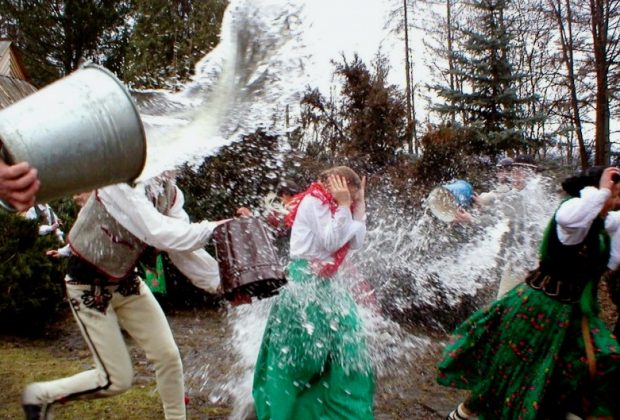
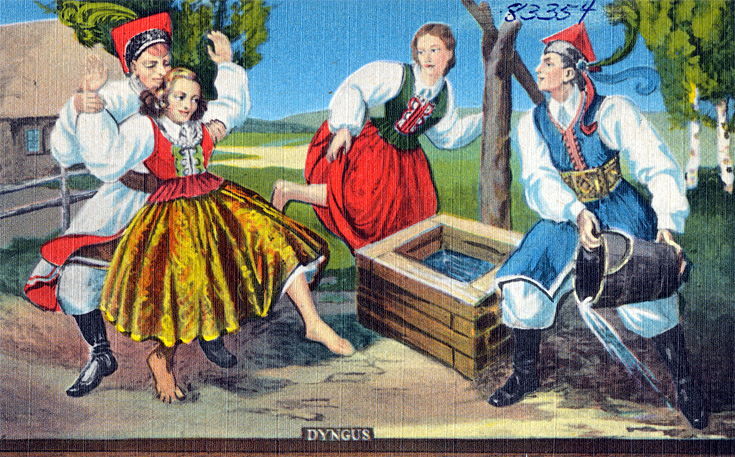
Today is Śmigus-dyngus, meaning “Wet Monday”, a holiday celebrated mostly in Poland. Traditionally boys would pour water on girl they fancy and and spank them with pussy willow branches on Easter Monday, and girls give them an egg, money, brandy or gifts in return! Folks nowadays can still get carried away with all-day water battles, but most just sprinkle family members with water and exchange gifts. The origins of the celebration are uncertain, but it may date to pagan times before 1000 AD; it is described in writing as early as the 15th century.
After all the water had been thrown, the screaming girls would often be dragged to a nearby river or pond for another drenching. Sometimes a girl would be carried out, still in her bed, before both bed and girl were thrown into the water together. Particularly attractive girls could expect to be soaked repeatedly during the day… Girls could save themselves from a soaking by giving boys “ransoms” of painted eggs (pisanki), regarded as magical charms that would bring good harvests, successful relationships and healthy childbirths. Although in theory the girls are supposed to wait until the following day to get their revenge by soaking the boys, in practice both sexes throw water over each other on the same day.
It continues to be observed throughout Central Europe, and also in the United States, where certain patriotic American elements have been added to the traditional Polish ones. It’s mostly a case of light sprinkling of water