Three KPMG partners sanctioned over $32m Westpac audit pitch
KPMG Toxic Culture
“(The) culture of fear, retribution, and revenue growth at all costs (within KPMG) is not acceptable,” the statement said.
“It is KPMG’s toxic culture and its thirst for improved partner remuneration at all costs that have resulted in them not being listened to or acted upon.
”It is unacceptable to be retaliated against for calling some of these actions and behaviours out, but is instead an obligation of all KPMG employees around the world.”
The whistleblower raised concerns with the firm’s senior leadership team in 2024 that confidential board papers from Lendlease were stolen and used to pitch for, and win, audit contracts from other firms such as Westpac and Dexus.
Beyond Red vs. Blue: The Political Typology
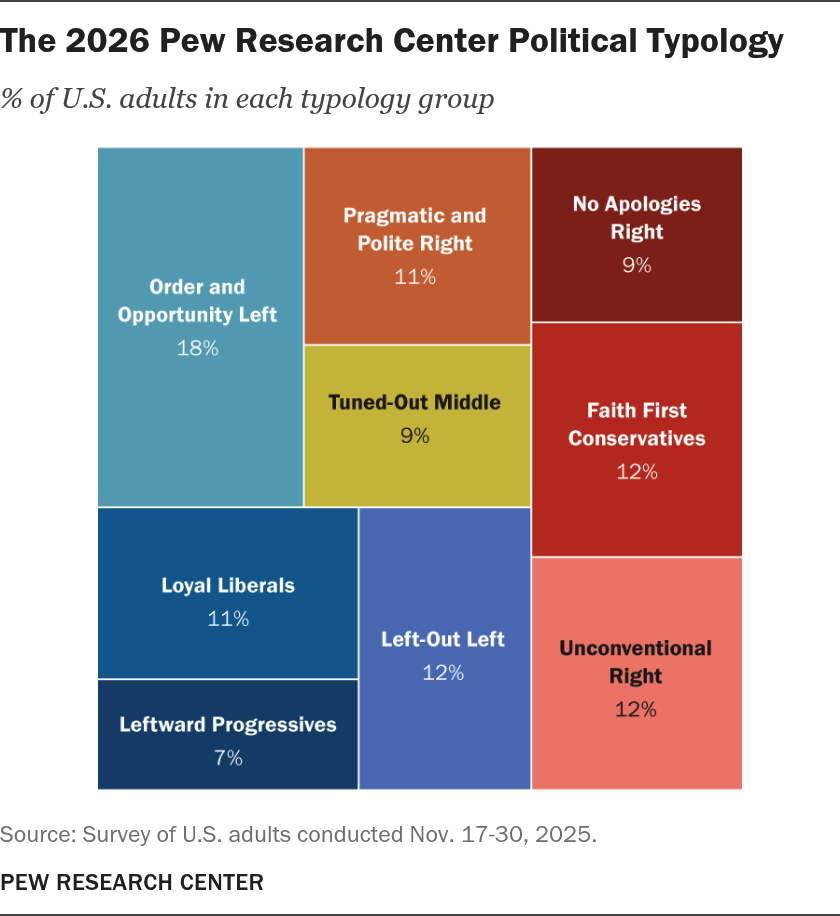 Pew Research: Nine groups show the conflicting values underlying today’s polarized politics. American politics is deeply divided along partisan lines – and for many Americans, the choice between the two parties feels stark, even existential. But beneath that familiar red-blue partisan divide is a much more nuanced picture: Many Americans hold a complex mix of values and beliefs that don’t always fit neatly into either major party. Pew Research Center’s new political typology shows how this complexity plays out, sorting the public into nine distinct groups based on their political and cultural values, not their party.
The result is a picture of American politics with far more than two colors in it. A few groups are very ideological, partisan and politically active. But they are a minority: Most Americans fall into groups within a large, politically messy center – even as many of them clearly favor one party over the other. These cross-cutting sets of values present challenges for both the Republican and Democratic parties.
To build winning coalitions, they must address the concerns of people who don’t fully support either party’s agenda. The most ideological and partisan Four groups are highly ideological, politically engaged and overwhelmingly back one party over the other – two on the right and two on the left. The right anchors (21% of the public) On the right, two groups are dominated by conservative Republicans who are unwaveringly supportive of President Donald Trump:
No Apologies Right and Faith First Conservatives. The two groups share many conservative values, but they differ in both emphasis and style. No Apologies Right take harder-line positions on most issues, but Faith First Conservatives stand out more on topics closely tied to religion, morality and social traditionalism. Both groups are majority Christian, and they are largely male and White – though to varying degrees.

