This election will be the first for the Legislative Council held without the group voting system, which heavily favoured a wide range of fringe parties, from those who like to hug animals to those who like to shoot them, along with assorted potheads and a solitary One Nation MP.
Figures show recent 10% rise in total held in financial centres such as Jersey and Panama, raising fears over cost to public purse
Jess Wilson should win. But bookies shouldn’t pay out yet
The votes for what used to be minor parties will decide whether one or both of the two major parties remain in the final count to elect the winner.
John Black Election analyst
Poll Bludger’s tracking polls on the Victorian state election have the Coalition leading Labor on the two-party preferred vote by 53.3 per cent to 46.7 per cent.
This solid lead has improved over the past month and now looks so strong that Sportsbet at the weekend had the Coalition at $1.05 to win government.

Labor leader Ben Carroll is predicted to not only lose the election, but also to lose his seat. News24
At odds this short, Sportsbet would normally be tempted to pay out before election day, as it famously did to backers of Bill Shorten to win the 2019 Australian election, when the odds for Labor dropped to $1.16.
Unfortunately for Sportsbet, Shorten didn’t win, and its payout cost the bookmaker $1.3 million, plus the $5.2 million it later had to pay those punters who backed Scott Morrison. Oops.
I think the odds do favour a win for Coalition’s leader Jess Wilson over Labor’s Ben Carroll, and I’ll explain why below, but Sportsbet should hang on to their money until after Saturday, just in case.
Redbridge’s latest poll has the Coalition polling a primary vote of only 33 per cent, a swing of 1.5 percentage points against the Coalition since the 2022 state election, and Labor candidates are polling a derisory 22 per cent, a drop of 14.7 percentage points since 2022.
This gives the two major parties little more than half the statewide vote and, clearly, the other half of the votes for what used to be minor parties will decide whether one or both of them even remain in the final count and which party’s preferences will be counted to elect the winner.
Of the nominally minor parties, the Greens are on a primary vote of 15 per cent, picking up almost 5 percentage points since 2022, and One Nation is just ahead of Labor, on a primary vote of 23 per cent, almost all of which has been gained since the 2022 election, when One Nation ran candidates in only five seats.
Our detailed profiling of the South Australian state results reflected a qualitative change in the demographic profile of One Nation voters during the past 12 months. Highly paid professional urban Liberals have swung towards Labor over climate change. Aspirational migrant families have swung from the political right to both Labor and the Greens, and older, sicker and poorer Australian-born voters have realigned to One Nation from Labor, the Liberals and especially from the Nationals.
We see similar statewide trends in Victoria, with net gains to the Greens and net losses from Labor and the Coalition to One Nation, but in Victoria there have also been big statewide swings directly from Labor to the Coalition, which we clearly didn’t see inflicted on a relatively popular Labor government in South Australia.
To project these trends down to individual seats and pick 88 likely winners, we applied the South Australian One Nation model to all Victorian seats. We then reweighted the Coalition, Greens and Labor votes to comply with the latest Poll Bludger statewide polls and completed a seat-by-seat calculation for all seats with significant Climate 200 campaigns.
With 45 seats needed for a majority, we projected 47 seats for the Coalition, against 32 for Labor, six for the Greens and three for One Nation.
All 24 seats predicted to change hands are held by Labor. The Coalition is expected to win 19 of those seats, One Nation three (Greenvale, Cranbourne and Melton) and the Greens two (Albert Park and Northcote). Labor is projected to lose too many seats to list them all, but unfortunately for Ben Carroll, his seat of Niddrie is one of them.
This election will be the first for the Legislative Council held without the group voting system, which heavily favoured a wide range of fringe parties, from those who like to hug animals to those who like to shoot them, along with assorted potheads and a solitary One Nation MP.
Our Legislative Council projections have the Coalition winning 16 out of 40 seats, needing five extra seats for a majority.
Depending on the issue, this majority could come from the nine remaining Labor MPs, nine One Nation MPs or six Greens. Given the reality of political bargaining, a Coalition government would have to be pretty inept to not grab a majority from at least one of these other political groups on any given issue.
This would appear to be a pretty comprehensive win for the Victorian Coalition, so why the caution from your humble election analyst?
Future elections in Australia will focus on the dwindling share of primary votes won by the old major parties and how this plays out in individual seats. For instance, a late swing this week of 1.1 percentage points to ALP candidates in seven closely contested seats could produce a minority Labor government, in partnership with the Greens.
For the Coalition, a drop of only 0.5 of a percentage point in four seats would force it into an alliance with One Nation, and a drop of only 1 percentage point in a handful of close seats could leave the Coalition relying on a lengthy count of preference leakages from a range of Greens, One Nation and independent candidates to hang on to a minority government.
So, if you’ve backed Jess Wilson to be elected premier based on her healthy lead on the two-party preferred vote, just don’t expect an early payout on Friday. And hope for a clear-cut result next weekend.

Victorian election: The state of play in your electorate

Victorian election: Who won the week?
While California’s wealth tax failed, states are taking other steps to collect more revenue from the rich
California’s tax measure (Proposition 40) failed. My colleague Darien Shanske was one of the architects of the initiative. Law professor Allison Anna Tait writes for The Conversationthat “[d]espite Proposition 40’s failure, I think it’s important to observe that many Americans expressed support during the midterms for hiking income taxes on the rich, and to a lesser extent, taxes on the second – or third or fourth – homes the very wealthy possess.” Check out her analysis.
Hackers planted malicious code on the websites of 178 major organizations, including Zoom, CNN, the BBC, HSBC and IKEA. Newsweek, November 17, 2026. Researchers at the cybersecurity firm Report URI found the attack on Monday, and it also hit Equifax, Salesforce, Fox News and Alaska Airlines, Newsweek reports.
Instead of breaking into each company, the hackers exploited a weakness in Optimizely, a service many major sites use to test different versions of their pages, so visitors could be exposed just by opening an affected site. The code was built to steal credit card details, swap cryptocurrency wallet addresses to redirect payments, and target older versions of iPhone and iPad software
Optimizely says it has fixed the problem and removed the code, but it’s still unclear how many people, if any, had their information stolen, and researchers have traced only about $7,040 in cryptocurrency to the attackers so far.
Just visiting a site doesn’t mean your information was taken, but anyone who entered payment details or sent cryptocurrency on an affected site on Nov. 16 should check their accounts. Update your devices, watch for charges you don’t recognize, and call your bank right away if you see one.
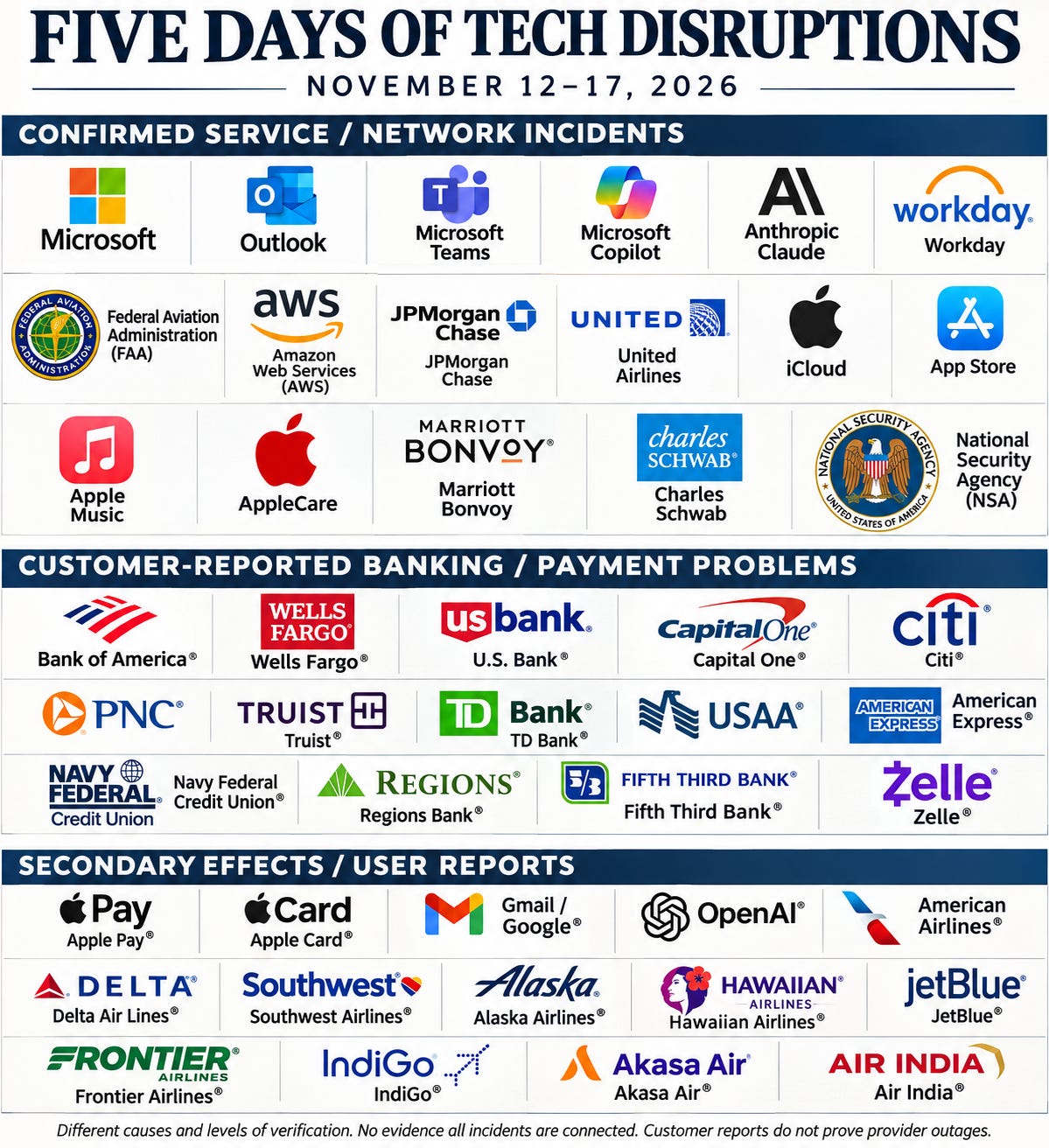
Quotes of the day via Reuters: “”If this is all a coincidence, it’s like the greatest coincidence in the history of the world,” US Senator Josh Hawley, a Missouri Republican, told reporters. Trump earlier played down the incidents, which raised questions of whether the government and private sector had moved too quickly in cutting tech staff. “It’s like when you’re big and powerful, and you have all the money. Things like that happen. It’s fine,” Trump told reporters in Manila, where he was attending the ASEAN economic conference.
Understatement of the day via this The New York Times headline – A National Meltdown With Nobody Manning the Help Desk. The digital outages that began on Thursday may not be linked, but they have left Americans with a sense that the nation is off-kilter, with no one ready to fix it.
See also: “A communications network used by the NSANet highly classified internal communications network went down. Nobody will say why, and you can add an outage to the National Weather Service to that outage ledger. “NOAA employed 2,437 meteorologists and hydrologists in September, the most recent month with available data, compared to 2,637 in January 2025. Many work for NWS, which lost more than 600 employees in 2025 to layoffs, early retirements and other staff reductions.
The White House reversed course later last year, authorizing NWS to hire 450 meteorologists, hydrologists and electronics technicians by the end of this September. But NWS fell short of the target, hiring 359 instead of 450, the agency told POLITICO in its first public statement…”
Trump DOJ Lawyers May Be Disbarred for Using AI to Write Briefs and Lying About It
Bloomberg Law News: “The Justice Department’s internal ethics watchdog has referred two of its attorneys for possible bar discipline over their use of artificial intelligence in conducting government work.
One of the lawyers filed an AI-generated brief with fabricated quotes and then made false statements to the court about it, while the other uploaded documents into a public AI platform in violation of a tribunal court’s protective order, said DOJ’s Office of Professional Responsibility in anonymized summary investigation findings published Tuesday. The findings highlight how growing scrutiny within the legal community over errors committed from relying on AI has spread to the federal government. Both of the lawyers violated their rules of professional conduct, OPR’s investigations concluded.
They have been referred to DOJ’s Professional Misconduct Review Unit, which can make recommendations to state bar authorities. The first lawyer’s case summary matched Bloomberg Law’s reporting on North Carolina assistant US attorney Rudy Renfer. The veteran civil litigator was fired in March and later formally reprimanded by a judge for filing the AI-generated brief in defending the government from a lawsuit and then lacking candor when addressing the court about his actions.
OPR concluded that the attorney “knowingly and intentionally violated” professional conduct obligations. In the second matter, the office determined the lawyer “recklessly” violated attorney conduct attorney ethics rules by using the public AI platform, which was also a breach of DOJ policy and the tribunal’s protective order.”

