The Last Viking leverages Nikolaj Lie Kaas and Mads Mikkelsen's finely tuned chemistry to anchor its cartoonish violence and offbeat humor, resulting in a film that's as sincere and affecting as it is bizarre.
“The world is full of people,” states the anonymous narrator of Anders Thomas Jensen’s The Last Vikingas an opening, hand-drawn animation tells a rather disturbing tale: there once was a viking prince who lost his arm in battle; his father, the king, decreed that everyone’s right arm also had to go. A quirky myth where disability becomes the norm sets the tone for what is now the sixth film directed by the Oscar-nominated Danish screenwriter, promising a wholesome arc to his typical brand of dark comedy. The animation is just a detour, the scene quickly shifting to the aftermath of a heist thriller with Anker (Nikolaj Lie Kaas) stashing a bag of money in a locker and asking his shy younger brother Manfred (Mads Mikkelsen) to swallow the key. Minutes later, police sirens drown out the frightened screams of their sister Freja (Bodil Jørgensen from The Kingdom: Exodus) amidst the tons of clutter the three siblings call their home.
Fifteen years later, Anker is released from prison and the first thing he does is, obviously, try to retrieve the cash; the trouble is, Manfred is not cooperative. He has since developed a condition that causes amnesia and split-personality disorder, kidnaps every dog he sees, and insists on being called “John”, after John Lennon. The definition of an oddball, Manfred / John is a brilliant character for Mads Mikkelsen to experiment with; mostly, it’s a role that’s not physical in a way that showcases the actor’s plasticity. He’s a bespectacled middle-aged man who’s timid and quiet until he’s volatile and hysterical––a surprisingly infantile character that brings out of Mikkelsen something we’re not used to seeing.
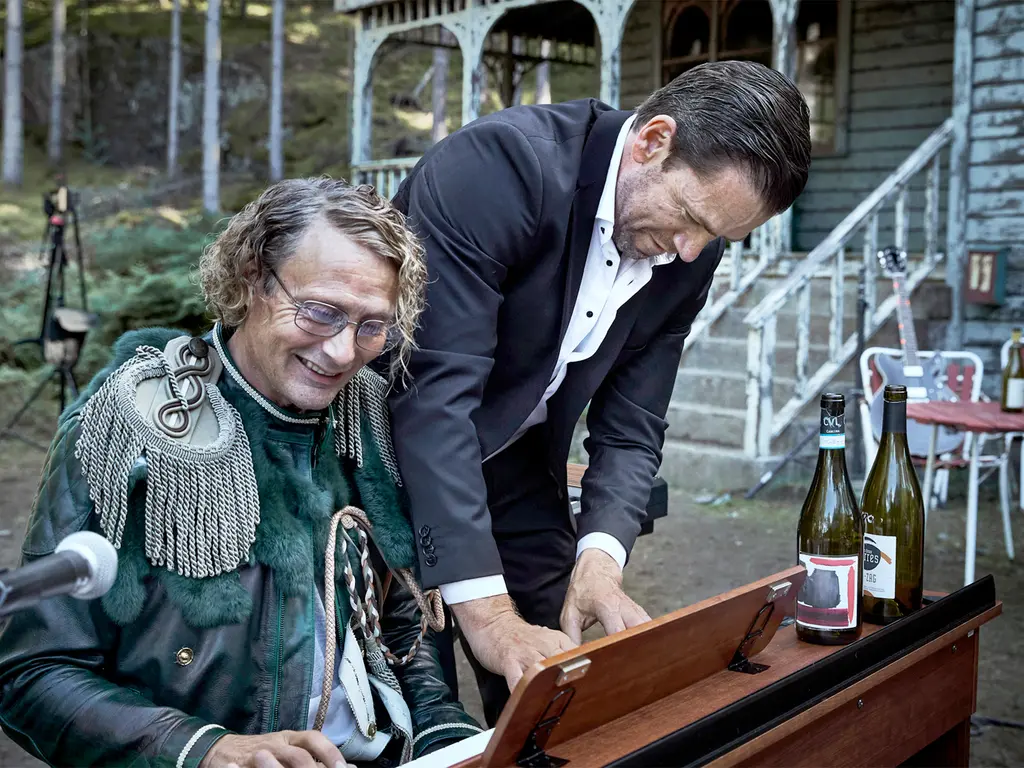
In fact, Jensen always manages to mine these weirdly soft performances out of the Danish actor, and a lot of that has to do with the consistency of themes and cast involved in all of his films––Mikkelsen, Lie Kaas, and Nicolas Bro (who plays the bad guy seeking revenge and money) rearrange themselves anew with each film, taking turns playing protagonists and antagonists. Even if you’re not familiar with the Jensen-verse of gentle giants, it’s likely you’d find The Last Viking touching––it weaves a lot of unspoken affection into its comedic settings. For example: the film’s middle act diverts from its heist-revenge plot to round up a number of Danish and Swedish psychiatric patients who share Manfred’s dissociative identity disorder diagnosis, and they start a band. Or, more precisely, they revive the Beatles. But they mostly play ABBA songs.
As a writer-director, Jensen is drawn to the figure of the underdog––always of the vulnerable kind––and The Last Viking is no exception to this rule. Anker and Manfred form two halves of the same whole, two broken men whose respective brokenness seems so incompatible that it miraculously fits––like siblings often do. Through a few flashbacks we learn that the boys had an abusive father who made their life living hell, a pre-teen Manfred often getting the harshest treatment for wearing viking gear to school. While these details shed some light on the symbolism of the title, this viking bit is code for an idiosyncratic take on masculinity, which Jensen’s films have always dissected with humor and tact. In his worlds, strength is a weakness and vulnerability an armor, which makes The Last Viking a perceptive take on men’s mental health––not through struggles, but a delightful mix of genre, meta-texuality, and positive affirmation masked as a Beatles song.
The Last Viking premiered at Venice 2025.
Throw it all into the pot – black comedy, crime thriller, emotional family drama, satire and then some – and you get this genre-jumping gem from Anders Thomas Jensen (Riders of Justice).
Here, Mads Mikkelsen is the withdrawn and troubled Manfred – who prefers to be called John, as in John Lennon. Call him Manfred and he will immediately try to commit suicide by any means he can find. Manfred has Dissociative Identity Disorder (aka Multiple Personality Syndrome) and he thinks that he is the famous Liverpudlian.
John (we shall now refer to him by his preferred name, so as to not upset him further) has clearly suffered trauma in his past. He’s the only one who knows precisely where millions of kroner stolen by his brother Anker (Nikolaj Lie Kaas) is buried. Anker has just finished a 15-year stint in jail, and he’s desperate to get his hands on the cash. As is Flemming (Nicolas Bro), Anker’s psychopathic accomplice in the robbery of a cash handling company.
The brothers find themselves at their old childhood home in the countryside, where the money is buried somewhere. But they are not alone. It’s an Airbnb now, and the new owners are there, and, via various circumstances, an ensemble of quirky characters with psychiatric issues along with a psychiatrist, Lothar (Lars Brygmann) from the ward where John was an inpatient after his most recent suicide attempt.
As the past is revealed in effective flashbacks, and the present is taken up by Anker trying to get John to tell him where the money is buried, there’s something else going on – a Beatles reunion of sorts, engineered by Lothar as a form of treatment for John. Lothar has tracked down two psychiatric patients with Beatles delusions – one who thinks that he’s Ringo Starr and one who believes he’s Paul McCartney or George Harrison, depending on which day it is.
It’s all quite amusing and occasionally laugh-out-loud funny, and the genre mash-up gels remarkably well … to a point. In the third act, the film veers into violence – this segment is unsettling and seemingly made for a different audience. It will potentially turn off viewers who were expecting a black dramedy.
Yet, with its themes of identity (nearly everyone here is deluded in some way) and trauma worked into Jensen’s cracking script, The Last Viking is generally a highly entertaining and sometimes emotional ride – just be prepared for that dark detour.
The Last Viking review – Mads Mikkelsen thinks he’s John Lennon in Von Trier-ish prankster comedy


