'Can you do my tax?': ATO, Services Australia prep for AI agents
Aussies will use agentic tech to access key services, officials say
Australians can expect to ask their own personal AI agents to complete tax returns and access government services for them in the future, officials from the Australian Taxation Office (ATO) and Services Australia said on Monday.
Artificial intelligence agents, otherwise known as agentic AI, are AI models which can autonomously complete multi-step tasks on behalf of their users.
While most consumers have had little exposure to AI agents, representatives from both the ATO and Services Australia told the Gartner IT Symposium/Xpo on the Gold Coast that they foresee taxpayers' AI agents directly interacting with government AI agents in the future.
Services Australia deputy CEO, Jonathon Thorpe, said he could see a future in which an individual's AI agent "potentially could do a fairly good job" of using their personal information and context to access the right government services.
"We're seeing – and I think anyone would attest this in most industries – that increasingly customers are experimenting with agents in their everyday life," he said.
"Increasingly, we're going to have to think about what that means in the context of government service delivery.
"... If you start to think about agentic systems or multi-agent systems, you could see a moment in time where you've got society, consumer, customers starting to do this themselves."
The ATO's chief information officer Mark Sawade agreed.
"I think we'll be in a world where we'll be eventually talking to our personal agent, saying, 'All right, it's now mid-July, can you please just fill out my income tax return?'
"And the personal agent will talk to one or more other agents through the government ecosystem," he said.
'We're not there yet': The security and liability concerns
Both Thorpe and Sawade admitted government agencies were still a long way from directly engaging with AI agents used by Australians, due to current technological limitations and security and liability concerns.
"Where it starts to run into a lot of trouble really quickly is proving who someone is," said Thorpe from Services Australia.
"And at the moment, we don't have the plumbing necessary for agentic identity, particularly in the consumer and citizen space.
"I think we'll solve it, but it's not here yet."
A key challenge is "liability and responsibility" if things go wrong, Thorpe said.
"What happens if you set up an agent and you didn't quite set the appropriate guardrails? What's government's responsibility in that interaction?" he said.
Sawade agreed that government services are "a long way" from embracing AI agents from individual users, and identity issues are "one of the key things we'll need to solve".
"But if we're not thinking about how do we get there now, and the types of building blocks we'll need to put in place, it'll be an incredibly long time before I think we'll be ready to have government services that are safely and securely and transparently interacted with in in that way," he said.
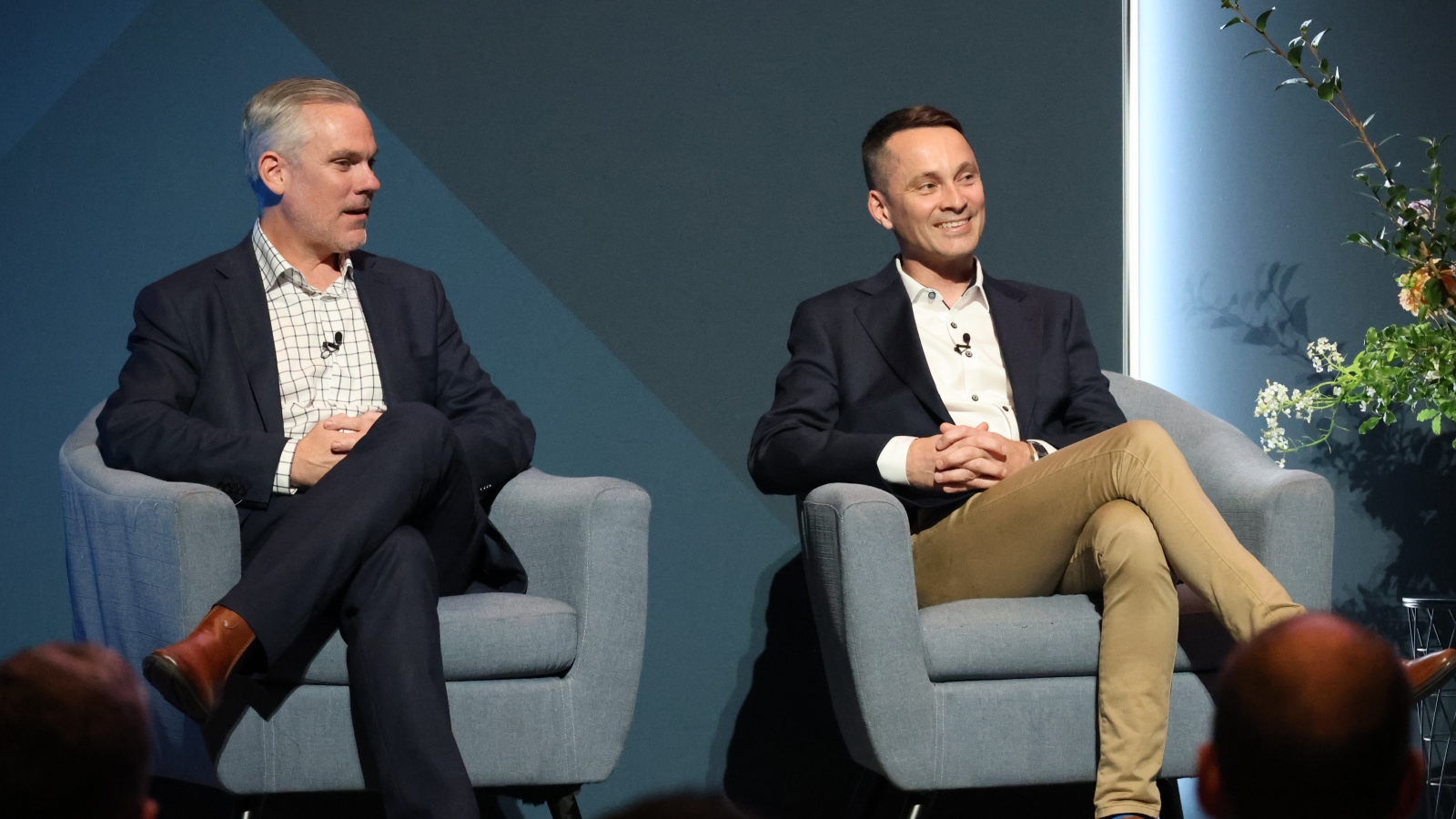
ATO chief information officer Mark Sawade (left) with Services Australia deputy CEO Jonathon Thorpe (right) at the 2026 Gartner IT Symposium/Xpo. Image: Gartner / Supplied
Internal agentic opportunities likely 'a lot easier'
Thorpe from Services Australia, which delivers government programs such as Centrelink and Medicare, said he saw agentic AI opportunities within organisations as "in some ways ... a lot easier".
"That being said, I think we'll still need to work out: Are they on organisational charts? Who's responsible for the agent deployment? How do you deal with machine speed assurance?"
Thorpe added that Services Australia is "quite cautious" about how it applies generative AI, and sees the technology "as an opportunity to evolve that service and make it better, not replace it".
"I do think there's places where agentic can play a better role, and that could be assisting our staff," he said.
"I don't think it's in front of our staff – I think it's I think it's actually behind it.
"How AI can support public servants to do a better job and better inform the community about what obligations, payments, and services are available to them."
These techniques are among what Services Australia is "looking at now as we transform our contact centre", Thorpe added.
Services Australia released its first AI and automation strategy in May 2025 – which did not explicitly mention agentic AI – after publicly defending its trials of AI technology.
The organisation's national manager of enterprise architecture and cloud engineering, Darren Vrettas, was gifted tickets to attend IBM's Agentic AI Summit in November 2025, according to Services Australia's gift disclosures.
Sawade from the ATO, which this year warned taxpayers against using AI in their tax returns, told the conference that his organisation had put generative AI "in the hands of as many of our staff as we can" to help with administrative tasks.
But he added the ATO workforce has "an appetite to go faster".
"They would like to be able to see where we could automate a whole range of different opportunities to give a better experience for both our staff and in terms of our mission," he said.
"We've had to be really, really careful about ensuring that we've got the right foundations in place. We've got transparency, we've got observability, and we've got a way of industrialising our use of AI with a lot of confidence.
"Because, quite rightly, we'll come under a lot of scrutiny for where we choose to start using AI – not so much in those administrative-type tasks – but where we are thinking about how it might add real value in those rewired business processes inside the ATO."
Gartner analyst Dean Lacheca said, "Success with agentic AI will depend on modern governance, workforce readiness, and the ability to redesign business processes, while creating an adaptable foundation for future innovation."
Interdependency and the ATO: A tale of two views
The ATO is placing more emphasis on whether a relationship displays a “strong commitment to a shared life” in the most recent Private Binding Rulings on interdependency, Michael Hallinan, special counsel for SUPERCentral, said.

Australian Taxation Office
Hallinan said the primary issue of whether the relationship between the adult child and the parent is one which is a “close personal relationship” but more importantly whether that relationship exhibits a “strong commitment to a shared life”.
“Defining interdependency has four requirements and each must be satisfied for an interdependency relationship to exist. They are domestic support and personal care, financial support, living together and a close personal relationship,” he said,
“Can an adult child and a parent be in an interdependency relationship? In the view of the ATO it seems highly unlikely as the ATO considers that an adult child and a parent cannot satisfy the ‘close personal relationship’ requirement of an ‘interdependency relationship’. The ATO seems to identify a ‘close personal relationship’ as being equivalent to a mutual commitment to having a shared life above and beyond that of a parent/child relationship.”
However, Hallinan questioned whether the ATO’s view is supported by the relevant legislation.
He said the term “interdependency relationship” is defined in section 302-200 of the Income Tax Assessment Act 1997 and has an identical definition in the Superannuation Industry (Supervision) Act 1993.
“The Tax Act determines the taxation treatment of a death benefit while the SIS Act determines whether the death benefit can be paid as an income stream” he said.
Hallinan said historically, the term “interdependency relationship” was introduced by the Superannuation Legislation Amendment (Choice of Superannuation Funds) Act 2004 (No 102/2024) and was originally introduced into the 1936 Tax Act (as s27AAB).
When the superannuation provisions were transferred to the 1997 Act, that section became s302-100 and there have been no material amendments to the term since 2004.
Furthermore, he added, the Income Tax Amendment Regulations 2005 (No 7) amended the Income Tax Regulations by introducing Regulation 8A which provides a shopping list of matters which should be taken into account (where relevant) to determine the existence of an “interdependency relationship”.
Following the relocation of the superannuation provisions from the 1936 Act to the 1997 Act, Regulation 8A was enacted (without material alternation) as Regulation 302-200.1 of the Income Tax Assessment (1997 Act) Regulations.
The definition contains four requirements mentioned previously and each of these requirements will be considered using the situation of an adult child providing care to a parent.
The requirement of having a “close personal relationship is usually the most difficult to satisfy in an adult child/parent situation, Hallinan said.
“The difficulty is twofold. First, the expression has no precise or generally accepted content. Secondly, the difficulty of direct proof and the consequent reliance of inferences from the conduct of the adult child and parent,” he said.
He continued that the explanatory memorandum to the legislation, which originally introduced the term “interdependency relationship”, describes a “close personal relationship” as one “that involves a demonstrated and ongoing commitment to the emotional support and well-being of the two parties” and that the indicators of a close personal relationship may include “(i) the duration of the relationship; (ii) the degree of mutual commitment to a shared life; and (iii) the reputation and public aspects of the relationship (such as whether the relationship is publicly acknowledged”.
“Significantly, the explanatory memorandum provides that ‘the above indicators are not an exclusive list and none of them are required for a close personal relationship to exist’,” he said.
Additionally, he said, the explanatory statement for the regulations which introduced the predecessor to regulation 302-200.01 stated that “Generally speaking, it is not expected that children will be in an interdependency relationship with their parents.”
“While the concept of ‘interdependency relationship’ was clearly introduced in 2004 to cover same sex relationships where the relationship was marriage-like the concept has a broader application which is clearly evidenced by the express statement that the three marriage like indicators are not an exclusive list and that none are required for a close personal relationship to exist.
“Further, the shopping list of factors, many of which are plainly features of marriage like relationships, are to be taken into account, but only where relevant. Finally, the expressed recognition that a child/parent relationship could constitute an interdependency relationship (albeit the relationship would be exceptional in nature) clearly shows the concept is not limited to marriage-like relationships.”
Hallinan said in many PBRs on whether an adult child and their parent are in an interdependency relationship, the “close personal relationship” requirement is held to be not satisfied because there was no mutual commitment to having a shared life above and beyond that of a parent/child relationship.
“With respect, there seems to be an established view of the ATO that for a ‘close personal relationship’ to exist there must be a marriage like relationship. If there is a marriage-like relationship between two individuals, then it can usually be inferred that a close personal relationship will exist. However, the issue is not whether a marriage-like relationship exists, but whether the relationship which exists between the two parties is a close personal relationship,” he said.
“If a relationship between an adult child and the parent satisfies the ‘living together’ and the ‘domestic support and personal care’ requirements, then this would take the relationship beyond the normal adult child/parent relationship.
“Further, if the adult child has significantly altered his or her life by relocating residences, putting their employment or career or personal life on hold to care for the parent, this would clearly establish a close and personal relationship given the personal cost to and sacrifice borne by the adult child. While the relationship will be terminated upon the death of the parent and so, the relationship is not of an indefinite duration or even of a long duration, while the relationship exists it will be of an exceptional nature.”

