Dr Cope’s friend who loved books even more than he does
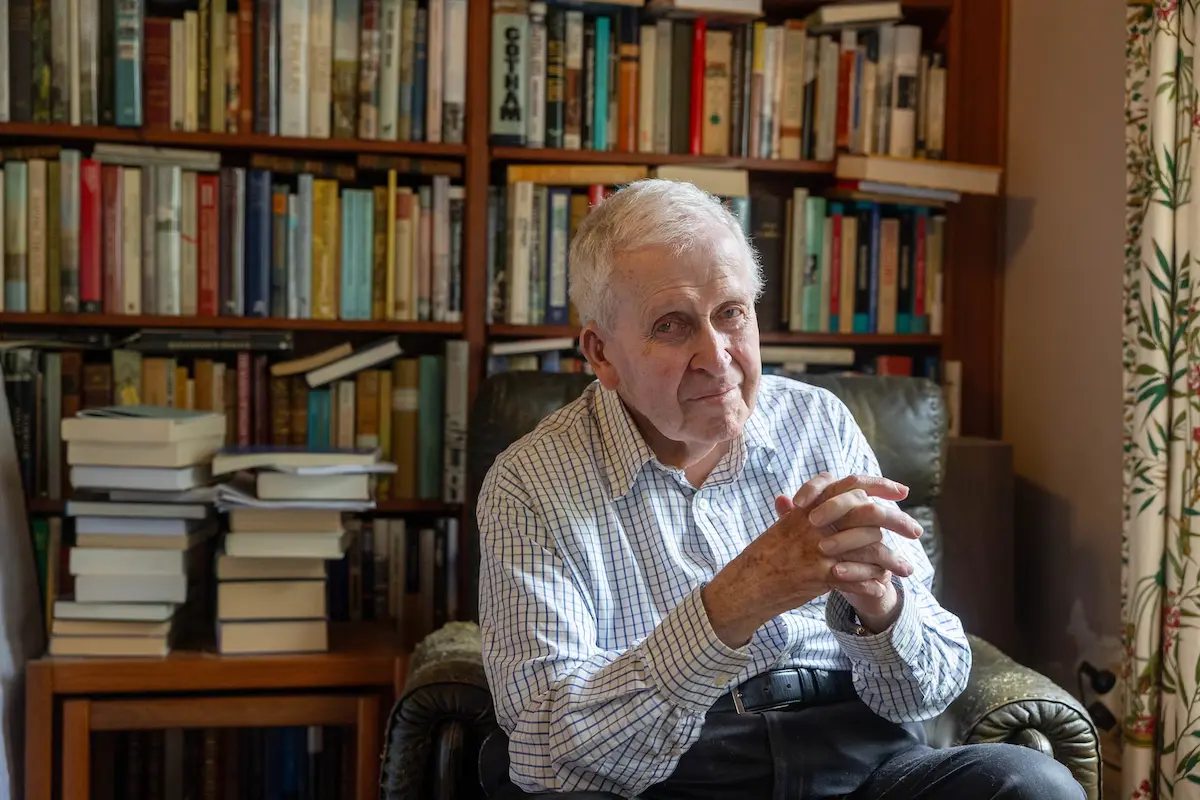
Wallace Kirsop, 92, is one of Australia’s foremost experts in rare books – not just their contents but their makers, buyers and readers, and the stories they tell beyond the page
One of Australia’s most eminent scholars in French Studies and in book-trade history, he was elected to the Academy in 1980.
Wallace taught French language and literature at Monash University from 1962 until 1998 and was appointed Honorary Professorial Fellow in the School of Languages, Literatures, Cultures and Linguistics upon retirement.
He was editor of the Australian Journal of French Studies from 1968 until 2002 and founding editor of the Institute for the Study of French-Australian Relations (ISFAR) journal Explorations from 1985 until 2008.
We extend our sincere condolences to Wallace’s family, friends and colleagues. He will be greatly missed.
An obituary is being prepared by the Fellowship and will be available in due course.
Wallace KIRSOP (1933 - 2026)
Associate Professor in French (1967 - 1998)
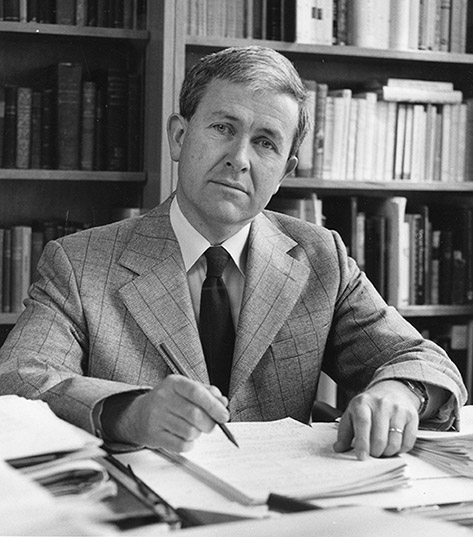
Professor Wallace Kirsop, who has died aged 92, was one of Australia's most distinguished scholars of French studies and book history, a pioneering academic at Monash and a tireless advocate for libraries and rare book collections. Over a career spanning more than six decades, he transformed the study of books in Australia and helped establish the intellectual foundations of rare books, special collections and bibliographical scholarship throughout the country.
Though little known outside academic and library circles, Kirsop's influence extended far beyond them. Generations of researchers, students, librarians and readers benefited from his efforts to preserve and understand the physical history of books. He was among the first Australian scholars to insist that books should be studied not only for the ideas they contain but also as material objects, yielding insights and clues into the societies that produced, owned, sold and read them.
For Kirsop, a book was a historical artefact. Its paper, watermarks, bindings, bookplates, annotations and inscriptions all had stories to tell. He often lamented that the term "bibliography" was widely misunderstood as merely the listing of books. His French colleagues preferred a more evocative description: the "archaeology of the printed book".
Kirsop's international reputation was such that he became the only Australian ever invited to deliver the prestigious Sandars Lectures in Bibliography at the University of Cambridge in 1981, one of the highest honours in the field.
Professor Kirsop began his long association with Monash after being appointed senior lecturer in French in 1962. Promoted to associate professor in 1967, he challenged the conventional approaches to language teaching at that time. He believed French studies should encompass social and cultural history as well as literature, introducing students to broader historical perspectives influenced by the French Annales school. Alongside language and literary studies, he taught bibliography, book history and textual studies, helping inspire a generation of Australian scholars interested in the history of print culture.
Beyond teaching, he took a keen interest in the affairs of his department, faculty, the University and much that lay beyond it; one of the few subjects which didn’t appear to arouse his curiosity, as one colleague recently observed, was rock and roll. Through his work with Friends of the Monash University Library, established in 1966, he was instrumental in making the Monash library one of the strongest university repositories in Australia, housing an outstanding French collection. Along with his graduates, it was an achievement of which he was most proud.
Professor Kirsop also played a central role in establishing and leading the Centre for Bibliographical and Textual Studies and its successor, the Centre for the Book. Together, these institutions cemented the University's reputation as a major centre for book history research. Following his retirement in 1998, he was appointed Honorary Professorial Fellow and continued as an adjunct professor, remaining scholarly active until the end of his life. His 560th publication appeared a month before his death.
Professor Kirsop combined a deep respect for the printed word with an openness to scientific innovation. He owned neither a computer nor a mobile phone, yet he was no technological reactionary. In 2017, when questions arose about the dating of a rare 1497 edition of Dante's Divine Comedy owned by the University of Sydney Library which contained a hidden red-chalk sketch and a handwritten death notice attributed to the Renaissance master Giorgione, he welcomed the use of the Australian Synchrotron's X-ray fluorescence microscopy to analyse the volume on a molecular and atomic level.
Professor Kirsop took particular satisfaction in the discovery, noting that it disproved assumptions that finds of global significance could not emerge from Australian collections. He warned against what he described as a “new parochialism” in collecting, arguing that libraries must continue to acquire international material essential to understanding Australia’s place in a multicultural and interconnected world. He remained convinced that printed books possessed an enduring permanence that digital technologies could never fully replicate.
Much of his life was devoted to what he once called "serial agitation" on behalf of libraries and their users. Beginning in the early 1960s as a volunteer cataloguer of French holdings at the State Library of Victoria, he spent decades advocating for the preservation and expansion of research collections. He served as president of the State Library Users Organisations' Council and remained an active member throughout his life.
As public and university libraries increasingly embraced digital collections, Kirsop, by all accounts a modest man, became a vocal and eloquent defender of original printed work, maintaining that serious scholarship, particularly on books produced before 1801, when each hand-pressed volume was unique, required direct examination of multiple surviving copies. His arguments were vividly illustrated by the celebrated Divine Comedy case, now regarded as one of the most valuable books in Australia.
Born in Chatswood, New South Wales, Wallace, or "Wal" as he was known to friends and colleagues, was the son of William Kirsop, an accountant and keen cricketer, and Doris Ida Kirsop, née Harris. Educated at North Sydney Boys High School, he went on to the University of Sydney, graduating in 1955 with first-class honours in both French and German.
He travelled to France and undertook doctoral research at the University of Paris. In 1960 he was awarded a doctorate for a thesis on Clovis Hesteau de Nuysement, the Renaissance poet and alchemical writer.
Returning to Australia that year, he lectured in French at the University of Sydney before moving to the newly-established Monash. There he would spend the remainder of his academic career and become one of the University's foundational figures.
His scholarly influence extended through publishing. In 1969 his foundational study, Towards a History of the Australian Book Trade, exposed how reliant early Australia was on imported British publishing. From 1968 to 2002 he edited the Australian Journal of French Studies, one of the field's leading international journals, receiving unsolicited material from Europe and North America. He was founding editor of Explorations, published by the Institute for the Study of French-Australian Relations, to which he also made numerous contributions, and served on the board of the Society for the History of Authorship, Reading and Publishing.
A founding member of the Bibliographical Society of Australia and New Zealand, which he served as president from 1969 to 1971, Kirsop was recognised as one of its most distinguished members. So highly was he regarded that the society later established the Wallace Kirsop Conference Bursary in his honour. His retirement was marked by the publishing of The Culture of the Book, Essays in Honor of Wallace Kirsop involving five editors and 38 contributors, illustrating the breadth of his work and the global esteem in which he was held.
Professor Kirsop’s achievements were recognised internationally. In addition to being elected a Fellow of the Australian Academy of the Humanities in 1980, he was appointed Chevalier des Palmes Académiques by the French government in 1973 and promoted to Officier in 2003. In 1999 the University of Sydney awarded him an honorary Doctor of Letters.
Books, of course, lay at the centre of his private life as much as his professional one. Together with his wife of 63 years, Joan, he assembled a personal library of some 20,000 volumes, many centuries old, which lined the walls of their Melbourne home and eventually overflowed into a neighbouring apartment. Shared with a string of feline friends, the house became a monument to the couple's lifelong passion for books. Kirsop donated numerous rare works to the State Library of Victoria, which today houses a collection bearing his name, and bequeathed the remainder of his library to that institution.
Professor Kirsop's scholarship helped establish Australia as a serious centre for the study of book history. At a time when expertise in rare books and bibliography is becoming increasingly scarce, his career stands as a reminder that books are more than vessels of text: they are witnesses to history itself.
Wallace Kirsop - 4 November 1933 - 12 August 2026
Published 19 August 2026
Wallace Kirsop was an Australian scholar in French studies and book trade history

