Am…am I “alternatively influential”? Defined roughly as “public thinkers and tastemakers who have real clout in their own demesnes despite only modest internet followings”

Artificial Intelligence and the Future of Tax Law
Bloomberg Law, Artificial Intelligence and the Future of Tax Law: A 3-part series:
Don’t Trust AI, Always Verify. Tax Law Still Needs Humans—Pt.
Who Merits the Longest NY Times Obituaries?
Using the NY Times Archive API, journalist Ted Alcorn built Below the Fold, a dashboard through which you can explore the last 25 years of Times coverage: 2.2 million articles containing 1.5 billion words. You can slice and dice this data in a bunch of different ways — it’s a fantastic resource.
One of the site’s sections is about obituaries. From that data, Alcorn produced this infographic of whose obits contained the highest word count:
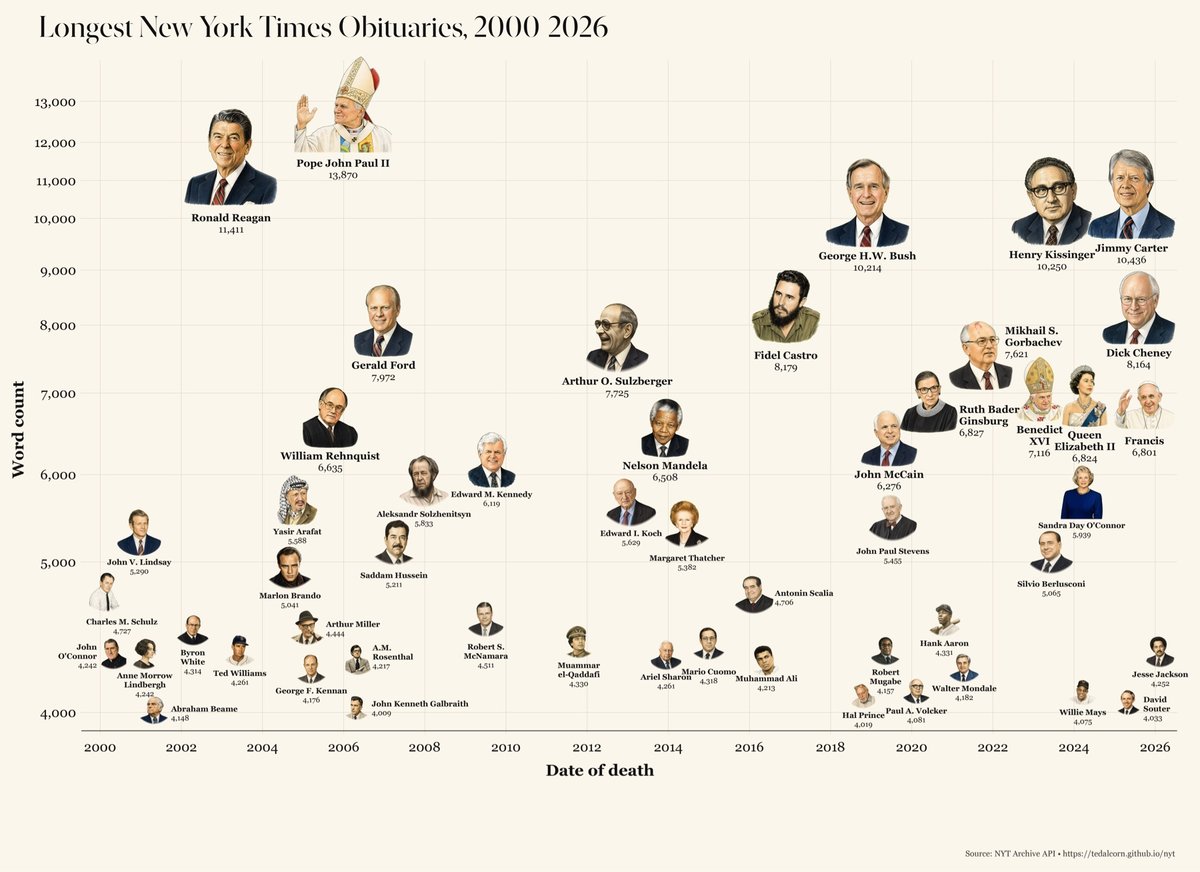
As you can see, it’s a lot of world leaders, religious leaders, politicians, and white men. There only appear to be five women on the list. Notable non-politicians include Aleksandr Solzhenitsyn, Muhammad Ali, and Charles Schulz.
The whole dashboard is fun/enlightening to explore
Near-Death Experiences and the Christian Hope of Heaven
Christianity Today: Are Near-Death Experiences Evidence for Heaven?, by Andrew Wilson (Pastor, King’s Church London; Author, Remaking the World: How 1776 Created the Post-Christian West (2023)):
Writing about heaven is different from writing about other Christian doctrines. Some books on the new heaven and new earth are so imaginative and speculative that they become untethered from biblical reality. Others are not imaginative enough; they make lots of accurate statements but lack the fusion of poetry, consolation, metaphor, wonder, and joy that characterize the apostles and prophets. Dane Ortlund’s new book, [Finally Home: The Christian Hope of Heaven(2026)], gets the balance just right more than any other modern book I have read on the topic. It is clear, solid, robust, and orthodox, but it is also soaring, evocative, comforting, and beautiful. It will be my go-to book to recommend on heaven from now on. …
[Michael Zigarelli (Messiah University), Evidence for Heaven: Near-Death Experiences and the Mounting Case for the Afterlife (2026)] presents three claims of escalating significance. Each of them is reflected in the title and subtitle.
The simplest and most defensible claim is that near-death experiences (NDEs) are much more common than many of us realize: They are experienced in all sorts of different cultures and are increasingly the subject of serious academic research.
The next claim is a bit stronger, namely that these experiences are so widely attested. Despite the wide range of cultures from which they come, NDEs have so many overlapping features—the departure of the soul from the body, heightened senses, overwhelming love, brilliant light, a journey through a tunnel, gaining special knowledge, a transformed life afterward—that they represent a growing body of evidence for the afterlife, in which the soul continues after the death of the body.
The third claim, as per the title, is that they actually represent evidence for the Christian doctrine of heaven, on the basis that they witness to a place of perfect peace, light, love, and joy after death, and in some cases a being from whom these things emanate.
Interesting thread about why rural towns don’t vote blue: they don’t have to because small towns “actually operate very similarly to the ‘socialist agenda’ they pretend to be so afraid of” and “they’ve already been having to take of their own…”

