Sad news reached us that Stephen Hill passed away
People talk about saints all the time, Stephen was one.
Stephen was a truly remarkable academic and public servant, leading in all his many roles with compassion and a deep belief in equality and equity for all. To boot, Stephen was one of the best friend of the national living treasures, John Hatton. We all shared many dinners together over the many years and all over the South Coast, usually after Kim’s jazz concerts 🎷
EMERITUS PROFESSOR
STEPHEN HILL OAM
Passed away suddenly on Saturday 7th March 2026. Dearly loved and loving father and father-in-law of Vanessa and Phil. Treasured Grandad to Chris and Emma, Jaime and Josh, Josh and Stella and affectionate Great Grandad to Xavier. Cherished friend of Yola.
Aged 82 Years
A kind and compassionate man who touched the lives of many.
Relatives and friends are invited to attend Stephen’s funeral service to be held at University Hall, Building 11, University of Wollongong Main Campus, on Wednesday 18th March 2026 at 11:00 am. For those unable to attend, the family invite you to view Stephen’s service via the link found on funeralannouncement.com.au
Published on 14 Mar 2026
Vale Emeritus Professor Stephen Hill AM FRSN FTSE
With thanks to Emeritus Professor Tony Hulbert FRSN for background information.
John Hardie AM FRSN
New book launch: the kindness revolution will save the world
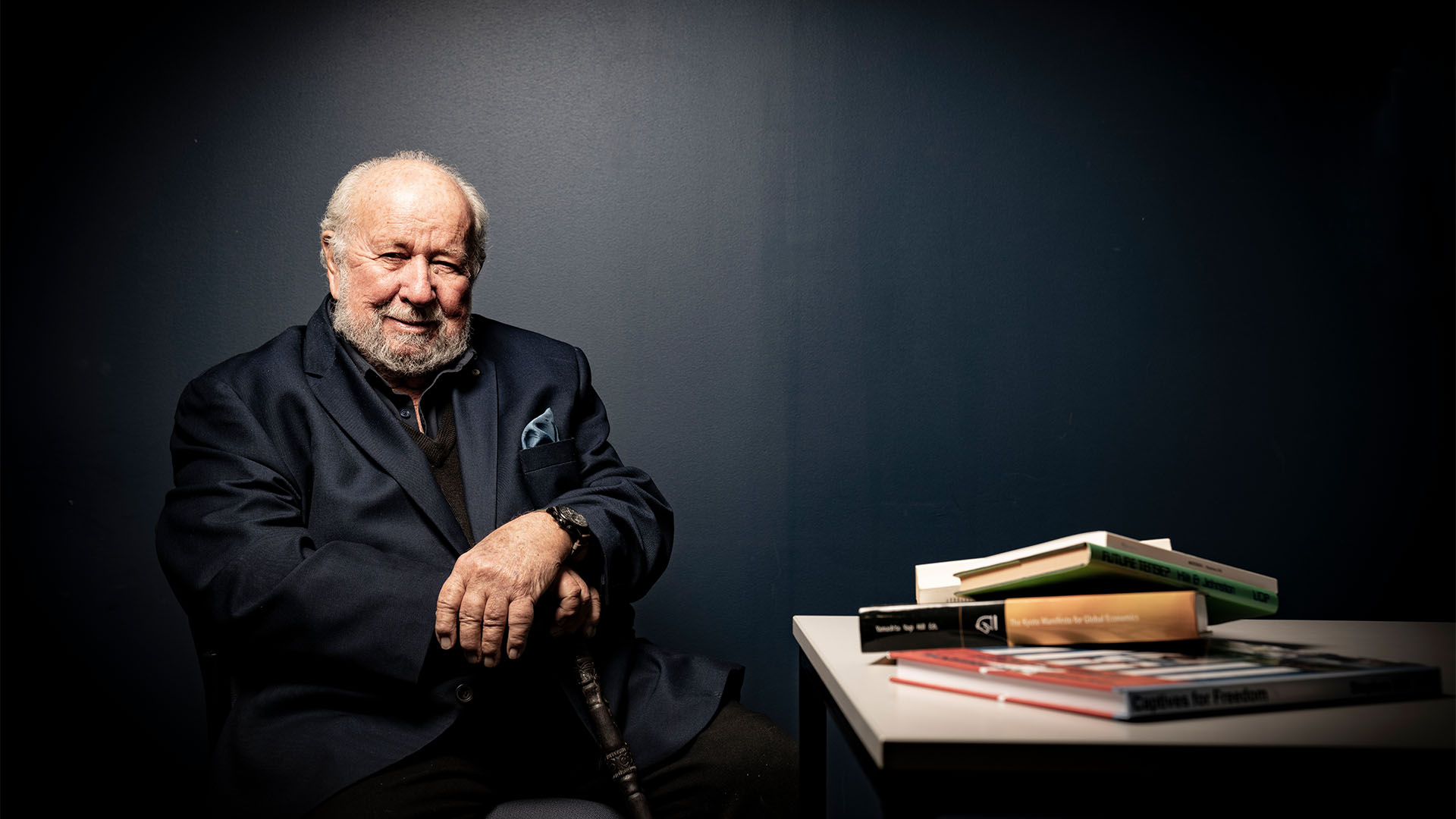
Stephen Hill’s book is both scientific and spiritual, as it presents his vision for post-pandemic economics based on humanity and care
What would happen if we re-framed the current economics dominated by self-interest to base all human relations on mindfulness, care, mutual benefit and trust?
In his newest book, The Kyoto Post-COVID Manifesto for Global Economics: Confronting Our Shattered Society (2022), the University of Wollongong (UOW) Emeritus Professor Stephen Hill AM, exposes the failures of a global economic regime and explores how shifting the paradigm from self-interest to humanity and cooperation can change our lives on all fronts: from sustainability, work arrangements, economic prosperity to global mental health.
Dr Hugh Mackay AO, a renowned social researcher and bestselling author of 19 books, including highly acclaimed Australia Reimagined, welcomed Professor Hill’s work with much excitement.
“This book is a profoundly original scientific and practical work. It calls us to rediscover our sense of humanity and express it by harnessing the power of local communities. It’s revolutionary, and revolutions like this never start at the top. Through Professor Hill’s storytelling, we’re invited to personal reflection and personal action at the grassroots level,” Dr Mackay said.
Unusually for a book on economics, it acknowledges the centrality of kindness to the human project – because according to the authors, human history is not about the survival of the fittest but the survival of the kindest, as our collective wellbeing doesn’t stem from aggressive individualistic progress but from harmony, inclusivity and cohesion.
Most importantly, Professor Hill shows that ‘the green shoots of transformation’ have already started emerging. For example, many societies now consider happiness and welfare far more important than economic growth, with key world economists supporting the idea of sharing economy. Similarly, numerous examples of modern businesses incorporate broader social values rather than just monetisation into their strategies.
In Professor Hill’s words, even the COVID-19 pandemic has had a positive side. It has shaken up world society and the global economy, leaving behind what could be decades of impact.
“The basic message it’s given us is strong – how now more than ever, we need to focus on a future ruled by our humanity rather than self-interest. And this is what my book strives to offer – the inspiration and practice to change out of an enormously unequal, fragmented global society,” Professor Hill said.
A significant impact of COVID-19, and an immediate opportunity for social change, has been the rapid development of computer-based communications and a change in home-office work arrangements. These changes have encouraged some leading organisations to revisit the human relations values that underscore productive employment.
One of the book’s unique ideas is ‘the Circle of Wholeness’, a poignant concept explaining that each person is only whole when connected into overall harmony with others as in a circle. Caring and knowledge are held by the circle’s central human focal point: integrity and trust.
The book was written in collaboration with Japan’s Center for the Creative Economy in Kyoto.
ABOUT THE AUTHOR
Stephen Hill is an Emeritus Professor at the University of Wollongong (UOW). His career covers multiple disciplines, supporting an overall concern to make knowledge work for peoples’ emancipation and welfare.
Immediately before retirement, Professor Hill was United Nations Regional Director for Science for Asia and the Pacific and, in parallel, Principal Director and Ambassador of UNESCO (the United Nations Educational, Scientific and Cultural Organisation) based in Indonesia. Before joining UNESCO, Professor Hill was Director of the Australian Research Council’s National Centre of Excellence and UOW’s Centre for Research Policy. At UOW, he spent 17 years as Foundation Professor of Sociology. Prior to that post, Professor Hill held Interdisciplinary Appointments in Chicago and Sussex, and was teaching Sociology at UNSW.
Stephen’s Lecture is the story primarily of his experience when working full time in the United Nations for eleven years, based primarily in Indonesia and part-time in Paris but covering much of Asia and the Pacific in a variety of roles – with particular responsibity for UNESCO and therefore, for the United Nations support for science, education and culture plus social science, communication, media freedom and World Heritage in an often ‘troubled world’. He and his UN staff were, at times, confronted by serious danger, for example, in Indonesia’s West Papua during and after two of his staff were taken hostage by Freedom Fighters for Independence, in community development in Mindanao, the Philippines, against a backdrop of direct terrorist threat, plus during a Revolution, a Tsunami and much more in Indonesia. Equally, however, he and his team were able to capture opportunities in such crises to make a sustained and empowered difference. As demonstrated in Stephen’s most recent book, “In Defence of Our Humanity”, at the heart of positive change was listening and responding in the peoples’ terms, and building a culture of community understanding, trust, and power for the people to take charge themselves.
Stephen Hill is an Emeritus Professor at the University of Wollongong (UOW). His career covers multiple disciplines, supporting an overall concern to make knowledge work for peoples’ emancipation and welfare.
Immediately before retirement, for eleven years, Stephen was the United Nations Regional Director for Science for Asia and the Pacific and, in parallel, Principal Field Director and Ambassador of UNESCO (the United Nations Educational, Scientific and Cultural Organisation) based in Indonesia and part-time in Paris within the UNESCO Director General’s Cabinet.
Before joining UNESCO full time, Professor Hill, spent 17 years as Foundation Professor of Sociology from age 30 (plus part-time professional rock and blues musician), after being a Research Scientist from the University of Sydney and Unilever, with Australia’s first PhD in Business Administration (from the University of Melbourne), and serving in interdisciplinary appointments in Chicago and Sussex as well as teaching Sociology at UNSW whilst also consulting and building UN networks and programs across Asia. Then for five years in the 1990s, he was appointed Director of the Australian Research Council’s National Centre of Excellence – UOW’s Centre for Research Policy, and, in parallel, chosen to be Australia’s official Foundation Chairman in APEC, the Asia Pacific Economic Cooperation Organisation. He is a prolific author of many articles and over twenty books, five in the last seven years, stretching from global economics to cultivating compassion, and life
John Hatton and Stephen Hill on ABC Illawarra radio with Nick Reingberger Humanistic Buddhism Centre
“We used to live in a Society.
Now we live in an Economy.”
- Hugh Mackay (2007)
“WE CAN MAKE A DIFFERENCE” Humanistic Buddhist Response to Modern Crises (FOREWORD)
'It's going to be very hard' for UOW to survive job cuts, founding professor says
Fifty-year connection to UOW
The Conversation - Stephen Hill is Emeritus Professor of the University of Wollongong
Stephen Hill LinkedIn
Speech by John Hatton - Celebrating the life of Ted Mack who requested that John’s speech be joyous and light and requested that he should not wear black outfit as his favourite colour was Yellow...
: : :
“Wendy Mack...The parent, the amazing partner, the force - - secretary, MEdia officer, election organiser, wise counsellor, “down to earth”.
The engine room. Competent, Loving a whole workforce in one. The wonderful, loving Mack family, our hearts ache with you.
This gathering is a mirror full of love, insight and respect for an extraordinary man.
Ted and I were born in the same year, 1933. As Ted used to put it, “the same year that Hitler came to power.”
Ted Mack was my friend. We shared a dream. We tried to read the dashboard of planet earth to fantom the journey; we tried and hoped that somehow we could influence the direction, distil meaning and at times enjoy the ride.
Like many,I feel privileged, inspired and enlightened by Ted Mack. A role model.
Ted’s Wikipedia details demonstrate how the speakers today have an impossible task to expressed in few minutes his achievements and his passion for giving power to the powerless...
His quirky way of thinking intrigued me. No garbage bins in North Sydney station - they attract litter. Freeways attract cars. Freeways, and their opposites, tollways, get you to traffic snarl quicker.
Privacy and “in-confidence” are myths. The smart money will always find out. Public tenders mean tenders in public.
The greed, the hypocrisy, the secrecy, the sheer audacity and the stench of politics at times threatens to drown us.
Yet idealism, the human spirit, the determination, the firm handshake of the true believers, the friends and bedrock family, transcend and uplift.
Together on the backbench of the NSW Parliament we witnessed the disconnection. Vaudeville; his the villain, cheer the hero; the theatre, the actors, the disconnect from Henry Lawson’s “The Faces in the Street”.
This disconnection is decease inflicting all levels of government in Australia.
On the backbench Ted’s attention was on integrated transport planning, public finance, dismantling of the people’s institutions - e.g., Government Architect Branch in the Pubclic Works Department. Loss of the people’s advocate in assessment contracts, town planning design, public services, protection of crown land. The privatisation putrage; secrecy, cover-up, blatant dishonesty buying elections: thecrumbling of the pillars of an inclusive civil society. Few in power listened. The sale of electricity, water, roads, Land Titles Office; an endless list.
Ted’s knowledge instructed me. The Swiss government. The American Constitution. The essence of the Westminster system. The media. An Australian republic.
Always stimulating, inspiring with his original thinking. Ted was in innovator, a watchdog, champion of the freedoms and obligations of civil society. He set the high standard by example.
In his book “The Unconscious Civilisation”, John Reston Saul states (and I paraphrase) Democracy is a system that facilitates the obligation to dissent. That is active involvement the obligation necessary to distil the essence of democracy.
Leading social researcher Hugh Mackay observes:
👌🏼We used to live in society. Now we live in economy...
Corruption of language. Words swords cleave truth and humanity into meaningless pieces.
The economic model of competition, the economic rationalists, the titans of politics and business (read “banks”) obliterate trust, empathy, honesty, spiritual values and community.
Emeritus Professor Stephen Hill, a firmer UN ambassador (with astonishing experience of multicultural societies worldwide) and a fan of Ted Mack, emphasises that the loss of the local is the loss of meaning - the most human and cultural connection.
In light of these things, Ted Mack’s life, his wisdom and his actions tick all the right boxes.
Yes, we grieve. We miss him. Australia will miss him.
Today, skim of the dross, reveal the shining metal of our humanity. From the mirror ball of memories draw meaning, determination and strength from Ted Mack’s example.
One person of principle, courage and persistence is a formidable force - the essence of Ted Mack. That is inspiration. Do it. Live it. An exciting, meaningful and fulfilling life.
I leave you with a delicious thought. In the most unlikely event that a party politician makes it to heaven, only on arrival to find that God is independent and holds the balance of power for eternity
Thanks Ted
Thanks Wendy and family.
We love you

