Later mum had a fridge magnet that said 'Dull women have immaculate homes
~ James Rebanks,
Later I would understand that modern industrial communities are obsessed with the importance of ‘going somewhere’ and ‘doing something with your life’. The implication is an idea I have come to hate, that staying local and doing physical work doesn’t count for much.
~ James Rebank
This crappy, mean, broken-down school took five years of my life. I’d be mad, but for the fact that it taught me more about who I was than anything else I have ever done. It also made me think that modern life is rubbish for so many people. How few choices it gives them. How it lays out in front of them a future that bores most of them so much they can’t wait to get smashed out of their heads each weekend. How little most people are believed in, and how much it asks of so many people for so little in return.
Wainwright prize for nature writing goes to James Rebanks for English Pastoral
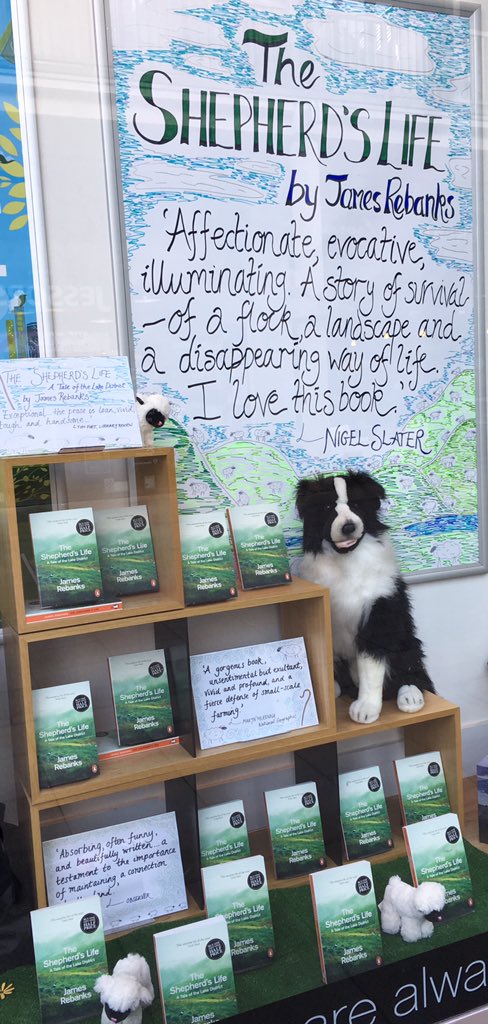
The Shepherd’s Life: A Tale of the Lake District by James Rebanks – review
Farmer-writer James Rebanks: ‘The older I get, I think: cut yourself some slack’
The Lake District author on the graft and beauty of a shepherd’s life — and why the future of farming should be inspired by its past
She was called Lily, this cow,” says James Rebanks, as we dollop beef stew on to our plates. We are sitting in the Rebanks family’s farmhouse nestled beneath a snow-crested Helvellyn in the north-east of England’s Lake District, a wood burner glowing to one side keeping out the frigid December air.
It may be reassuring for some to know the exact origin of their food, and disconcerting for others, but there can be little doubt that Lily had the shortest journey to plate of any Lunch with the FT.

This beef is off a two-year-old Belted Galloway heifer that only ever ate grass in her whole life on our farm, never had any medicines, never lived inside a day in its life,” adds the man who, thanks to a series of books and a lively Twitter account, might have become the most influential farmer in the UK. @herdyshepherd1 began on social media in 2012 showing daily life on his upland farm shared with several hundred hardy Herdwick Shepherd sheep, 20 Belted Galloway cattle, a bevy of sheepdogs, and an increasing number of other wildlife from fieldfares and barn owls to pine martens and great egrets. He quickly discovered a thirst from city dwellers to reconnect with the land and see another side of life in the Lake District, an area most know only as tourists and fell-walkers.
From there, he has gone on to become a best-selling author, transporting readers to his Cumbrian fell farm in The Shepherd’s Life and, most recently, launching an impassioned appeal in English Pastoral for farming to abandon its high-intensity, heavily fertilised modern methods and return to a past of working in harmony with nature.
It’s a past I have a connection to — my grandparents were farmers on the other side of the Lake District; my mother’s cousins still farm there — and I spend much of the long journey up the M6 motorway thinking of the many childhood holidays I passed among the fells. I go to any valley in Norway and it’s very, very similar. We totally understand each other within five minutes Warmly installed in the farmhouse’s main room, we soon start talking about Norway, my current home. Rebanks’ next book is set there, on a remote island in the north featuring one farmer’s old-fashioned way of doing things.
Rebanks, clad in a dark green Craghoppers fleece and green jeans, intends to spend the first half of 2022 finishing it off. He is effusive in praise for both the country and its politics, farming or otherwise. “I love Norway; it’s the one place I could live apart from here,” the 47-year-old adds.
The links between the Lake District and Norway are stronger than many might expect. Many words are close to identical: beck (stream), bairn/barn (child), kirk (church), fell/fjell (mountain), dale/dal (valley). Rebanks would say he was going “ga’an yam”, a phrase any Norwegian would recognise as “going home”. Another similarity is the type of fell farming Rebanks is used to, with sheep “hefted” to a specific area, meaning the animals learn over generations where their particular patch is and stick to it, removing the need for enclosed fields.
“I go to any valley in Norway and it’s very, very similar. We totally understand each other within five minutes. And, you think, huh, how can I be more at home in Norway than Sussex? But it’s sort of true, historically and linguistically,” Rebanks says. Rebanks’ wife, Helen, repeats that the stew is ready, and James portions it out with its deep brown sauce and cabbage and tatties (potatoes) on the side. He goes to the fridge for some horseradish sauce.
The casserole is excellent. Rebanks, who apparently isn’t a great fan of stews, signals his satisfaction too. Norway also stands out for its protectionist approach to agriculture. Not a member of the EU and outside the bloc’s customs union as well, Norway has high tolls on meat and dairy products from abroad. Rebanks is a big fan. “I would unashamedly argue that Britain should have a more protectionist agriculture, food and environmental policy because I think the three things are intertwined.
We need a profoundly different environmental and food outcome on our islands than we would have through a free market,” he says. Rebanks argues that farmers are needed, both to provide food and look after nature in their fields, hedgerows and more. But to do so, they need to be paid more, either through higher food prices or through more subsidies.
The proportion of our incomes spent on food has steadily declined in recent decades. But importing food from countries with lower environmental and welfare standards increases vulnerabilities in our own food security, he believes.
What things might become more expensive? What things might have to disappear a bit from our diets? Chickens and pigs in big sheds fed on grain and soy from the Amazon and Indonesia spring to mind. How would we feed ourselves?
Do we have to eat more seasonal British veg and fruits? Yes, we do. Might it mean that it costs 12 per cent of our household budgets to buy food instead of 7 per cent, which is what it is heading to? Yes.” His pessimism over politicians doing the right thing — especially after free trade deals with New Zealand and Australia that could be ruinous for British farmers — is tempered by optimism over public opinion.
“What you’re actually doing to almost every field in England is increasing the pressures which would make it less biodiverse, less sustainable. You’re asking it to compete with the most un-British landscapes on Earth, that do everything in monocultures and are highly specialised. There’s a complete nonsense to that,” he says. Rebanks gets us both a second helping of the stew, an undoubted benefit of eating at home. We start talking about soil, a subject he is almost evangelical about.
His big idea is regenerative agriculture, the idea that farming can help both biodiversity and the fight against climate change by returning to ways of the past. Later, he takes me for a ride around his 185-acre farm in his pick-up to show me what he means. Thousands of trees have been planted, old hedgerows have been re-established, and the least productive areas of the farm have been turned into ponds or left to grow wild. The results, according to Rebanks, are impressive. His farm is certified as carbon positive, taking more out of the air and into the soil than it emits, even despite the infamous methane burping of cattle.
He takes me to a hay meadow that alone has 108 types of plant living in it; the farm as a whole has about 200. I would unashamedly argue that Britain should have a more protectionist agriculture, food and environmental policy He now thinks of his farm as a chessboard, using the sheep and cattle in short bursts of grazing in a couple of the dozens of different fields and then after a day or three moving them on to the next one.
Each field gets a rest of between 100 and 150 days, improving the soil quality immensely and eliminating the need for artificial fertilisers. “The best way of feeding the ground, it turns out, is to let plants grow. Green plants photosynthesise, and pump masses of carbon and sugars through their own root systems into the ground. So, letting plants grow longer between grazings is a huge thing.
The second one . . . that the soil scientists have now explained to us is, particularly in summer, trampling of as much of that green matter into the surface so it begins to rot and the worms turn it into humus soil,” he says, admitting he has become a soil geek. Farming has increasingly been in the spotlight over its contribution to methane emissions.
The greater public attention has led in part to the rise of veganism and plant-based eating. But Rebanks fights back, arguing that agriculture has lower emissions globally than sectors such as transport or energy, and that grass-fed livestock are a small part of that. Instead, he believes farmers need to show they are the “best stewards of the land”, both in terms of producing food and protecting wildlife. But he leaves little doubt about the financial trouble with this.
His books may make money, but his farm some years does not, often just breaking even. Unsurprisingly, his farm is diversifying, as are thousands of others, into accommodation, soil schools and more. “It’s coming down to cultural choices now. I’m, like, I’m holding on. We can pay our bills. I want to do this because I want to do it,” he adds. Rebanks in effect grew up on two farms in the Lake District: his father’s, and his grandfather’s. He was inculcated in the ways of farming by both and left school at 15 with just two GCSEs, in woodwork and religious studies. In his twenties, though, he started night school and, encouraged by his new girlfriend, Helen, went to Oxford university to read history, earning a double first. He says he found Oxford bewildering in many ways.
He saw farming as a working-class pursuit but in southern England, with its gentlemen farmers, it was seen as often upper-middle class. “This is quite a strong, sweeping statement but I’ll stand by it. I think the Lake District is the least hierarchical, least class-based place that I know of in Britain,” he adds. The Lake District is one of the most beautiful parts of the British Isles, drawing some 20m tourists a year pre-pandemic.
But on returning there to farm, Rebanks found there was no representation of his native view of the Lake District and its farming culture. Instead, the guidebooks of Alfred Wainwright and others dominated with their tourist perspective. Over time, it led both to his social media account and the book that became The Shepherd’s Life. “Mine was a fierce farm boy kickback against that, basically. You can’t tell me who I am. This is what we are,” he adds. The Lake District is still fiercely fought over. The environmentalist George Monbiot has called it “sheepwrecked”, arguing that the fells should be full of trees but that livestock have devastated the landscape. Rebanks says he can deal with criticism but finds much of it lazy. Why should the Lake District return to how it was before humans more than any other region?
“I have put on social media in the past that I would much prefer London if it was a rewilded tidal estuary,” he says. “Touché.” English Pastoral followed last year as a more reflective, lyrical work. The book is both a paean to a former and, he believes, wiser way of farming, and an entreaty to change things before it’s too late.
He talks about learning to farm with his grandfather and the brief period when he signed up to modern farming, before gradually seeing the light and changing tack. He remains passionate, though. Just miles away from Racy Ghyll, some of the hotels on Ullswater have helipads. He proposes a charge for every car entering the area, to be given to local communities and farmers protecting the environment.
“Is the tourist money going to the poorest people in the Lake District? Is it going to the people that actually maintain the landscape?” It is time for dessert, a cake topped with loganberry jam provided by a family friend. We both add a good dollop of crème fraîche and wolf it down. “I hope you approve of this restaurant,” he says. I nod my head. The outside is beckoning. Rebanks shows me his “rewiggled” river, now twice the length, helping both flood defences — critical in an area that has suffered terribly in recent years — and wildlife on its banks. He is trying to create missing habitats such as willowy scrub, thorny scrub and wetlands.
The sun is disappearing behind the fell, and I’m suddenly grateful for my Norwegian thermal underwear. I ask about all the hats he wears — farmer, author, budding soil expert, father. “Some of the hats fall off from time to time.
I’ve just totally failed as a writer for the last six months and actually it gets to the slightly hectic part where I just ring my editor up and say, ‘I know you want a book, I want to write a book, but there’s no way I can do it before Christmas’,” he says.
Menu Racy Ghyll Farm, Matterdale Beef stew with cabbage and tatties Loganberry jam cake with crème fraîche Total £0 For all the idolising of his grandfather, he says he may have been a great farmer but he was probably not a great parent, often rolling in drunk from the pub. “The older I get, I think, hang on a minute, cut yourself some slack, James.
You’re probably a better dad than he was. Do I do everything as well as he does on the farm? Maybe not.” With two teenage girls and two younger boys, thoughts are already turning to the next generation. He says the “hilarious thing” is that, while he tries to be environmentally progressive, his daughters “are not exactly Greta Thunberg”.
“They don’t like anything that sounds like it isn’t farming. The culture is so strong. It’s stronger now than when I was a kid. I may have contributed to this,” he adds. We either accept we’re fairly brutal changers of the world and try to be a bit better at it, or come up with an answer that would get us out of the landscape The economics of farming is tough, though. He says to support his elder daughter he needs to find an extra £20,000 profit a year to pay her a wage. A shepherd’s hut could provide an easy £15,000 a year but to make the same from sheep “you’d have to be a very, very clever sheep farmer”.
He becomes philosophical, arguing that farmers need to meet any criticism head on, particularly from those who would rather “rewild”, or take the humans and farm animals completely out of an area. “There’s only really two options at the end of the day, isn’t there? Accept that we’re fairly brutal changers of the world and try to be a little bit better at it or a lot better at it, or somehow come up with an answer that would get us out of the landscape.” We drive up to his hay barn-cum-classroom-cum-writers’ den. He says he still wants to farm “every day of his life” but, with his daughters growing up, he sees a way of giving them more freedom by concentrating on his writing.
“I’m the luckiest man in the world, doing the two things I love the most. But in my twenties to forties I felt like a failure.
I’d no books, I’d lost my connection to the farm. Now, I know I’m not a failure. I’ve always felt like my job was to have my turn and pass it on.”
I head back to my car and slowly drive down the hill. In the rear-view mirror, I spy Rebanks loading hay bales into his pick-up, off to feed his cattle on another winter afternoon.
Richard Milne is the FT’s Nordic and Baltic correspondent
There is no such thing as bad weather, only bad clothes.
~ James Rebanks,
He asked what I made of the other students, so I told him. They were OK, but they were all very similar; they struggled to have different opinions because they’d never failed at anything or been nobodies, and they thought they would always win. But this isn’t most people’s experience of life. He asked me what could be done about it. I told him the answer was to send them all out for a year to do some dead-end job like working in a chicken-processing plant or spreading muck with a tractor. It would do more good than a gap year in Peru. He laughed and thought this tremendously witty. It wasn’t meant to be funny.