Monday, May 18, 2026

Kate McClymont - ‘Queen of Australian investigative journalism’ has another crown


‘Queen of Australian investigative journalism’ has another crown

May 18, 2026

For all the awards, accolades and nice things said about her over a four-decade career, Kate McClymont tends to eschew the recognition she thoroughly deserves.


One of Australia’s most celebrated reporters, McClymont is as grounded as they come. She can wander effortlessly through Sydney’s high-end cultural and academic scenes, but is at her happiest sitting in a grungy courtroom taking notes, or at her desk ferreting through a pile of corporate records. She does it all with grace and class, just the right amount of black humour and unending generosity to even the most junior of her colleagues.

Kate McClymont prepares for her honorary doctorate at Sydney University on Monday.STEVEN SIEWERT
As the likes of Eddie Obeid, Charlie Teo, Don Burke and Ron Medich have discovered, The Sydney Morning Herald’s chief investigative reporter is also tenacious, forensic, meticulous and fearless. Her work has held the powerful to account and uncovered corruption, fraud and criminal enterprise across politics, business, sport and society.

A winner of 10 Walkley Awards for excellence in journalism, including the outstanding contribution to journalism prize in 2023, McClymont has also been recognised by an appointment as a Member of the Order of Australia (AM) and induction to the Australian Media Hall of Fame.

We can now add “doctor” to the list of achievements after the University of Sydney on Monday awarded McClymont an honorary doctorate, honouring her accomplishments as an investigative journalist and deep ties to the university community.

Professor Catharine Lumby, who read the citation, said McClymont was often dubbed “the queen of Australian investigative journalism”. Lumby said recognising the Herald reporter’s work underscored the role investigative journalism played in democratic societies.
The Herald’s chief investigative reporter Kate McClymont. WOLTER PEETERS
McClymont is no stranger to the University of Sydney. She spent 10 years on its governing senate, including four years as pro-chancellor, and graduated in 1981 with a BA (Hons) in English literature. Mark Scott, the university’s vice-chancellor, also happens to be a former editor-in-chief of the Herald, as is his chief of staff Darren Goodsir.

“Kate is one of Australia’s most fearless and respected journalists,” Scott said. “She’s built a career on asking tough questions and refusing to look away.

“It’s hard to think of another journalist whose reporting has had such sustained impact. She has an extraordinary instinct for the public interest and a willingness to follow stories wherever they lead. That work hasn’t always been easy, but it has always mattered.”

The Herald’s editor, Jordan Baker, said McClymont had “done the people of this state and country a great service over more than 40 years in journalism”.

“At the Herald, Kate is loved not only for her fearless journalism, but for her wicked sense of humour, her love of a good yarn, and her collegiality; she is unfailingly generous with her wisdom and time, and has nurtured the development of many young reporters.”

McClymont told media graduates at Monday’s event that she hoped their careers would hold as much “colour and purpose” as her own.
McClymont is awarded her honorary doctorate. STEVEN SIEWERT

“Journalism is above all a privilege,” she said. “We have the ability to hold people to account. But if you want to hold powerful people to account, you have to be in it for the long haul and you have to be prepared to pay a price.

“There are two institutions to which I’m immensely grateful. The Sydney Morning Herald, now in its 195th year, has had my back over the most difficult times. And the University of Sydney, which taught me intellectual rigour and gave me lifelong friendships for which I will always be grateful.”

Other Australian journalists awarded an honorary doctorate by the University of Sydney include the Herald’s economics editor Ross Gittins, political reporters Michelle Grattan and Laurie Oakes, 7.30 host Sarah Ferguson, and broadcasters Geraldine Doogue, Caroline Jones and Ray Martin.

Sources & Confessions. Every observation on this page came from your own browser

 'Art is never finished, only abandoned.'

~ Leonardo da Vinci


Taken. You opened this page. It already knows the following

Sources & Confessions. Every observation on this page came from your own browser, in the first milliseconds after you arrived. The words were written by a human. A few honest footnotes follow. TAKEN

  • Your location – ip-api.com · Free tier · CC-BY-SA – Your IP address arrives in the header of every request your device makes. We pass it to ip-api.com to translate it into a city and an internet provider name. The lookup is transient. Neither side stores it. Under GDPR, an IP address can be considered personal data when used for tracking. We do not track. We do not retain. We do not log. We display only the first and last octet on screen. We know the rest. We chose not to display it.
  • Browser APIs – MDN Web Docs · Mozilla · CC-BY-SA 2.5 – Every observation about your device (screen, browser, language, GPU, cores, battery, fonts, preferences) was retrieved through standard JavaScript APIs documented openly by Mozilla. No exploits, no vulnerabilities, no hacks. Everything on this page is by design. The design is the problem.
  • The technique of detecting installed fonts by measuring rendered text widths has been documented since 2010. The EFF maintains a tool that lets you see how unique your browser is. Most browsers are unique enough to be tracked across the open web without any cookie at all. The combination of fonts is one of the strongest signals.
  • Canvas fingerprinting – Princeton University · Web Transparency & Accountability Project – A 2014 study from Princeton was the first to document canvas fingerprinting in the wild. Researchers found it on 5% of the top 100,000 websites: pages that secretly asked the visitor’s browser to draw a hidden image, then read the rendered pixels back as an identifier. Your browser supports the technique. We did not draw one. The page you visit after this one might.
  • Clipboard API – MDN · Clipboard API specification – With a single user gesture (a click, a tap), a page can request to read the last thing you copied. A password. An address. A draft message. The capability is announced by every modern browser. We did not request it. The capability is there, available to any page that asks at the right moment…”

Taxing Fellow Travellers: Who Merits the Longest NY Times Obituaries?

 Am…am I “alternatively influential”? Defined roughly as “public thinkers and tastemakers who have real clout in their own demesnes despite only modest internet followings”


Artificial Intelligence and the Future of Tax Law

Bloomberg Law, Artificial Intelligence and the Future of Tax Law: A 3-part series:

Don’t Trust AI, Always Verify. Tax Law Still Needs Humans—Pt. 


Who Merits the Longest NY Times Obituaries?

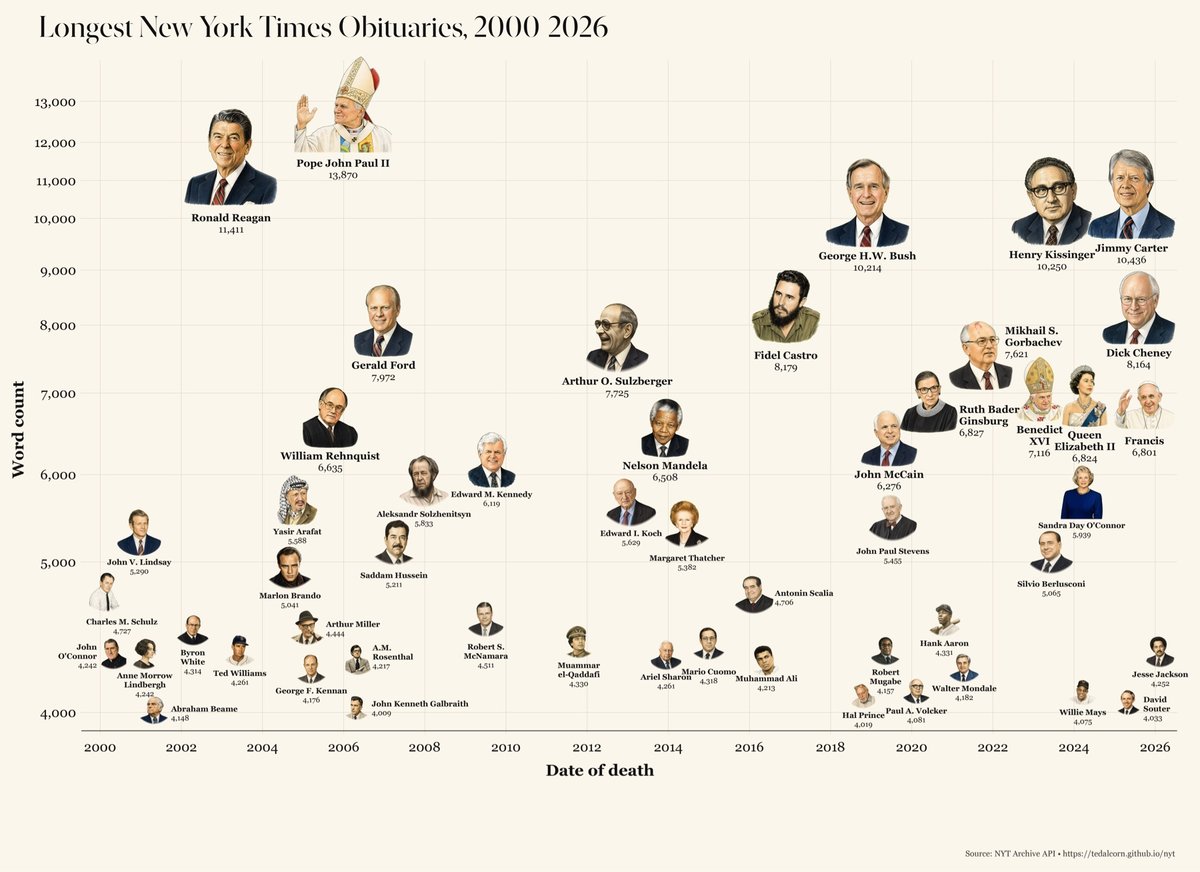
Using the NY Times Archive API, journalist Ted Alcorn built Below the Fold, a dashboard through which you can explore the last 25 years of Times coverage: 2.2 million articles containing 1.5 billion words. You can slice and dice this data in a bunch of different ways — it’s a fantastic resource.

One of the site’s sections is about obituaries. From that data, Alcorn produced this infographic of whose obits contained the highest word count:

As you can see, it’s a lot of world leaders, religious leaders, politicians, and white men. There only appear to be five women on the list. Notable non-politicians include Aleksandr Solzhenitsyn, Muhammad Ali, and Charles Schulz.

The whole dashboard is fun/enlightening to explore


Near-Death Experiences and the Christian Hope of Heaven

Christianity Today: Are Near-Death Experiences Evidence for Heaven?, by Andrew Wilson (Pastor, King’s Church London; Author, Remaking the World: How 1776 Created the Post-Christian West (2023)): 

Writing about heaven is different from writing about other Christian doctrines. Some books on the new heaven and new earth are so imaginative and speculative that they become untethered from biblical reality. Others are not imaginative enough; they make lots of accurate statements but lack the fusion of poetry, consolation, metaphor, wonder, and joy that characterize the apostles and prophets. Dane Ortlund’s new book, [Finally Home: The Christian Hope of Heaven(2026)], gets the balance just right more than any other modern book I have read on the topic. It is clear, solid, robust, and orthodox, but it is also soaring, evocative, comforting, and beautiful. It will be my go-to book to recommend on heaven from now on. …

[Michael Zigarelli (Messiah University), Evidence for Heaven: Near-Death Experiences and the Mounting Case for the Afterlife (2026)] presents three claims of escalating significance. Each of them is reflected in the title and subtitle.

The simplest and most defensible claim is that near-death experiences (NDEs) are much more common than many of us realize: They are experienced in all sorts of different cultures and are increasingly the subject of serious academic research.

The next claim is a bit stronger, namely that these experiences are so widely attested. Despite the wide range of cultures from which they come, NDEs have so many overlapping features—the departure of the soul from the body, heightened senses, overwhelming love, brilliant light, a journey through a tunnel, gaining special knowledge, a transformed life afterward—that they represent a growing body of evidence for the afterlife, in which the soul continues after the death of the body.

The third claim, as per the title, is that they actually represent evidence for the Christian doctrine of heaven, on the basis that they witness to a place of perfect peace, light, love, and joy after death, and in some cases a being from whom these things emanate.


 Interesting thread about why rural towns don’t vote blue: they don’t have to because small towns “actually operate very similarly to the ‘socialist agenda’ they pretend to be so afraid of” and “they’ve already been having to take of their own…”


Could Slovakia replace Hungary as EU’s main disruptor? DW

Sunday, May 17, 2026

I no longer listen to what people say, I just watch what they do

“I no longer listen to what people say, I just watch what they do.”

I don't have any bad habits. I'm good at all of them.


Recently Discovered Asteroid Will Sweep Past Earth at Close Range on May 18 — Here’s What to Know. “NASA’s Jet Propulsion Laboratory estimates that 2026 JH2 is somewhere between 15 meters and 35 meters (50 feet and 115 feet) wide; the higher limit of this estimate would be roughly equivalent to one-third the full length of an American football field.”


 The Beach (Planespotting) 


"The single greatest standard used in assessing the quality of a wine is complexity. The more times you can return to a glass of wine and find something different in it—in the bouquet, in the taste-the more complex the wine. The very greatest wines are not so much overpowering as they are seemingly limitless."

 - Matt Kramer, Wine Spectator, 2012.


The Bookseller

“The Booksellers is a 2019 feature-length documentary film about antiquarian and rare book dealers; you can watch the whole movie for free on YouTube. A behind-the-scenes look at the New York rare book world.”


The Guardian asked authors, critics, and academics to help compile a list of the best 100 novels of all time. They’ve done 41-100 so far. Selecting a book will show you who voted for it, then click on the voter’s name to see their other choices.


Giant Squid Longer Than a School Bus Emerges From 1,500ft Deep Off Australia


Saturday, May 16, 2026

Tatranka Time: Life After Life

To wake up each morning is a miracle.

Lailah Gifty Akita


Sometimes you seize the day. Sometimes the day seizes you. And you fight fire with fire.

~ Tatranka Sayings


Kemi Badenoch: I was perfectly clear. What I said was not what you heard; what you heard was not what I meant; and what I meant is whatever I now say I meant. I am always right. Put another way: I am never wrong.


There is a time for “a loop, a lap, or simply a repetition”? A “cycle or a circle” or “the retake and remake of the day”…

Painting by Picasso Archer 

In Nude Crust we Trust 


Coffee May Protect Against Aging, And Caffeine Isn’t The Main Reason.


 “It is hard to know when something ends and where something begins. “Or someone. Where a person starts or stops.”


         Hugh Lunn,  🐉 , George Negus (2001AD)


The Stewards We Choose 

The ways in which we opt into a generous world

After a three-week hiatus, I headed over to my sister’s house for a visit. She suggested it offhand the day before: “Hey, you should come see the backyard. It isn’t done yet, but we’ve been working on it.” She’s a master at downplaying her accomplishments, but I knew when she mentioned it that it would be worth seeing.

It didn’t disappoint.

Emerging from the disarray of winter, her garden was shining bright. Flowers bloomed in fresh beds of mulch, and vibrant groundcover blanketed the gentle hillside where fall leaves had been cleared. The space was full of life, and it was evident that a massive amount of energy had been poured into its revival.

Maintaining this backyard is a true commitment. It was originally created by the previous owners, who were passionate gardeners with the time and focus of empty-nesters. The view from the back porch captures a lush array of greenery, a stream flowing into a quiet pond, and a little manicured stepstone pathway winding through it all. When they sold the property, they chose my sister’s family over higher bidders, because they loved the idea of children enjoying the home they had built.

They chose their stewards well.

As we walked, my sister excitedly pointed out new plantings, trimmed trees, and improvements to the vegetable garden. She’s discovered that by doing just 30 minutes of work every day, she can keep up with it all. For her, it isn’t a chore—it’s a favorite escape.

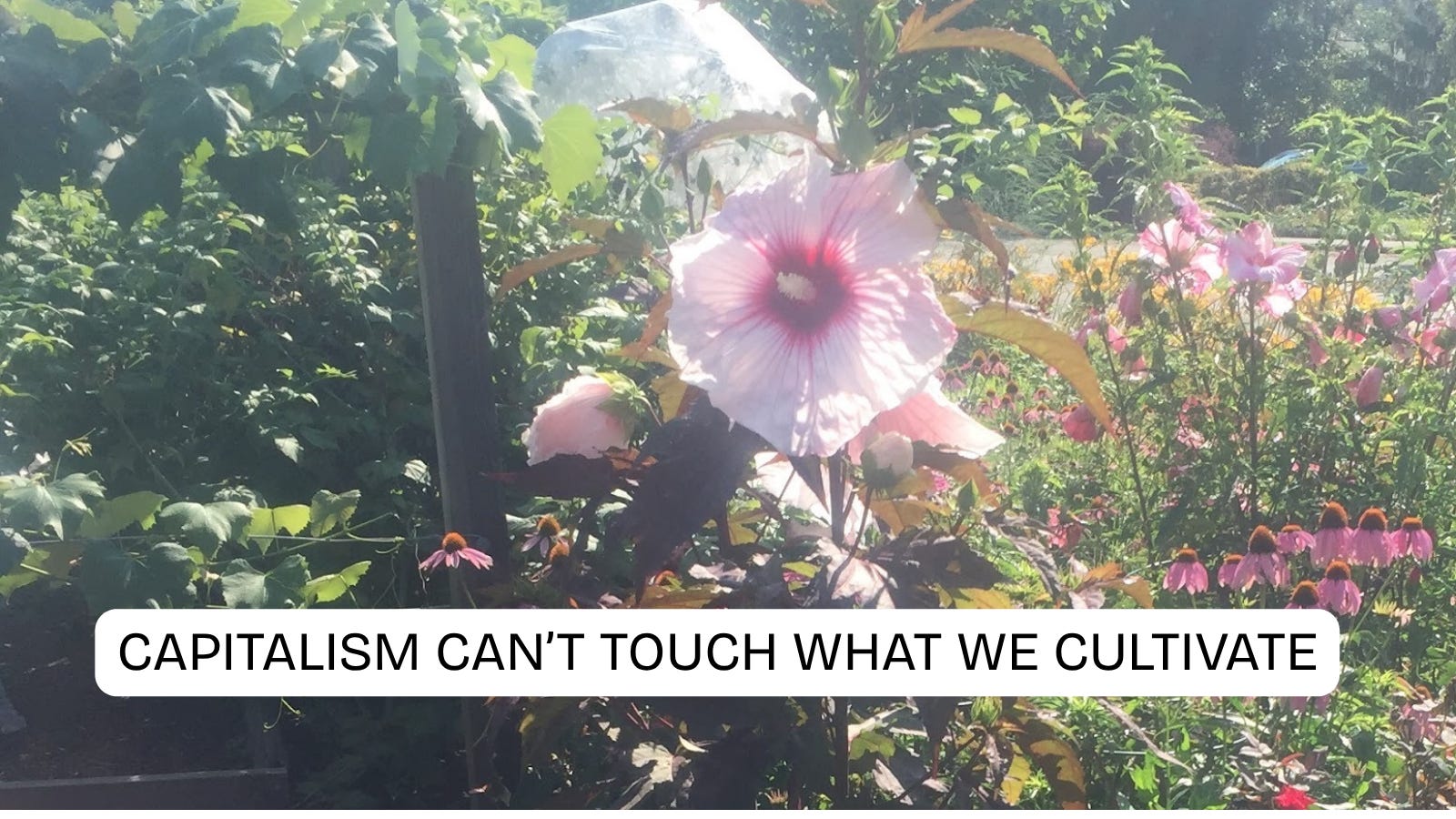
This exchange highlights the importance of our relationship to the land, even in a capitalist world.

When people feel a soul-deep attachment to their environment, they care for it well and pass it on thoughtfully. The idea of “maximum gain” begins to mean something far more than bottom line costs. Calculations of money and time are replaced by a sense of sustainability and legacy.

The bounty of nature is valuable, and it’s even more awe-inspiring when it’s shared. While the preservation of such a treasure is a responsibility, it is also a gift.

From church plant sales to “Friends of the Trails” groups, and from backyard caretaking to city park volunteerism, we are part of something beautiful when we connect to one another through nature. As our government challenges the definition of public lands, we are invited to explore that bond more deeply, and to participate more fully with our fellow citizens more fully in protecting what we love.

With love and hope for the future,

Stephanie


Near-Death Experiences and the Christian Hope of Heaven

Christianity Today: Are Near-Death Experiences Evidence for Heaven?, by Andrew Wilson (Pastor, King’s Church London; Author, Remaking the World: How 1776 Created the Post-Christian West (2023)): 

Writing about heaven is different from writing about other Christian doctrines. Some books on the new heaven and new earth are so imaginative and speculative that they become untethered from biblical reality. Others are not imaginative enough; they make lots of accurate statements but lack the fusion of poetry, consolation, metaphor, wonder, and joy that characterize the apostles and prophets. Dane Ortlund’s new book, [Finally Home: The Christian Hope of Heaven(2026)], gets the balance just right more than any other modern book I have read on the topic. It is clear, solid, robust, and orthodox, but it is also soaring, evocative, comforting, and beautiful. It will be my go-to book to recommend on heaven from now on. …

[Michael Zigarelli (Messiah University), Evidence for Heaven: Near-Death Experiences and the Mounting Case for the Afterlife (2026)] presents three claims of escalating significance. Each of them is reflected in the title and subtitle.

The simplest and most defensible claim is that near-death experiences (NDEs) are much more common than many of us realize: They are experienced in all sorts of different cultures and are increasingly the subject of serious academic research.

The next claim is a bit stronger, namely that these experiences are so widely attested. Despite the wide range of cultures from which they come, NDEs have so many overlapping features—the departure of the soul from the body, heightened senses, overwhelming love, brilliant light, a journey through a tunnel, gaining special knowledge, a transformed life afterward—that they represent a growing body of evidence for the afterlife, in which the soul continues after the death of the body.

The third claim, as per the title, is that they actually represent evidence for the Christian doctrine of heaven, on the basis that they witness to a place of perfect peace, light, love, and joy after death, and in some cases a being from whom these things emanate.