Sunday, May 30, 2021

Leadership of Bear Pit Proportions - Labor has lost the art of opposition: be smart, be tough and have a plan


Michael Daley to make another tilt at NSW Labor leadership

Member for Coogee Marjorie O'Neill said she supported Mr Daley, but also a rank-and-file vote for the leadership.


David Clune - Parliamentary Dragon and Historian - Remarkable victory for a fractured Coalition: now only a miracle can save Labor’s Jodi McKay


 NSW Labor Party elder Michael Knight – best known for his role as the minister for the Sydney Olympics – gave a sobering speech in March about the fortunes of opposition leaders. Knight began: “Leading a main opposition political party in any parliament in Australia is a temporary job, not a career. It either ends in becoming leader of a government, or it ends in tears.”

Speaking at the conservative-aligned think tank The Sydney Institute, Knight – who served for two decades in NSW Parliament – could not have known what was facing his party just two months later. However, Knight’s speech, titled Rock Stars or Dogged Competitors? How to pick an Opposition Leader, could not have been more prescient

Labor has lost the art of opposition: be smart, be tough and have a plan


Michael Knight: 192 cm tall tower - Rock Stars or Dogged Competitors? How to pick an Opposition Leader


Tanya Plibersek should be the next prime minister, but Labor is wasting her talents

Crypto Crackdown: Only the Beginning? If you think the officialdom is getting tough


  • Almanac: Elmore Leonard on falling in love
    “She raised her head and he saw her eyes, that gleam, that look that could change his life if he let it.” Elmore Leonard, Rum Punch Continue reading Almanac: Elmore Leonard on falling... Read more


    Crypto Crackdown: Only the Beginning?

    If you think the officialdom is getting tough with crypto, there’s even more they can do to tighten the screws.


    There is an eloquence in true enthusiasm.
    Separator icon
    Washington Irving

    This line comes from Washington Irving’s short story “The Adventure of the German Student,” which is actually a pretty dark and ghostly tale. But these words come at a joyful time in the story. The main character has just met a woman and immediately falls in love with her; at this moment he is explaining how he plans to take care of her. His earnest enthusiasm wins her over, and it's a lesson to take to heart. Time and again, when we let our joy and passion shine through, we’re rewarded with happiness.


    Bent Reality

    These surrealistic images were created by Cream Electric Art for a United Airlines ad campaign. Here’s a quick behind-the-sceneson how the Route 66 image was constructed. Prior art: Berg’s Here & There map of Manhattan, Inception, and these curved cityscape panoramas. (via moss & fog)


    Report: USPS ‘Internet Covert Operations Program’ Is ‘Much Broader in Scope Than Previously Known.’“The program ‘includes analysts who assume fake identities online, use sophisticated intelligence tools, and employ facial recognition software.’ . . . Based on what is now known about the surveillance program, however, it would appear that iCOP’s scope has gone way beyond merely monitoring potential threats to employees and infrastructure and has understandably raised serious privacy concerns.”

    Why is the Postal Service, which can’t seem to do its actual job, functioning as an internal security agency surveilling American citizens?


Study: Aboriginal Memory Technique Improves Recall

The students who used the Aboriginal memory technique were three times more likely to remember the entire list than they were before they were trained in this type of recall. The memory palace group were about twice as likely to recall the whole list, and the control group only improved by 50%. – Cosmos


Lateral Reading: Reading Less and Learning More When Evaluating Digital InformationSSRN. “To investigate how people determine the credibility of digital information, we sampled 45 individuals: 10 Ph.D. historians, 10 professional fact checkers, and 25 Stanford University undergraduates. We observed them as they evaluated live websites and searched for information on social and political issues. Historians and students often fell victim to easily manipulated features of websites, such as official-looking logos and domain names. They read vertically, staying within a website to evaluate its reliability. In contrast, fact checkers read laterally, leaving a site after a quick scan and opening up new browser tabs in order to judge the credibility of the original site. Compared to the other groups, fact checkers arrived at more warranted conclusions in a fraction of the time.” Lateral reading is what we do…. .


This Is What Banksy Gets For Saying ‘Copyright Is For Losers’

“In a new decision issued by the [European Union] IPO Cancellation Division, a trademark owned by street artist Banksy has been declared invalid. … The attorney who represented the opposing party in the case” — a greeting-card company — “said ‘the real nail in the coffin’ that led to the ruling was ‘the public comments of Banksy and his lawyer’.” – World Trademark Review


“Using event study analysis of recent minimum wage increases, we find that these changes do not affect the likelihood of searching, but do lead to large yet very transitory spikes in search effort by individuals already looking for work.”  Link here.


All the more reason to call it “The Norwegian Century.”

Every digital child

 Last week was my birthday.  

My wife didn’t wish me a happy birthday and my children did not acknowledge my special day. 

I went to work and none of my co-workers wished me a happy birthday. 

I felt sad. 

But when I entered my office, my personal assistant called out, “Happy birthday, boss!”  

That was lovely.  

My assistant then asked me to go to lunch with her. 

We stayed at the bar after lunch and then we went to her apartment.  

While at her apartment, she said, “Do you mind if I go change into something more comfortable? 

“Sure,” I replied.

My birthday had gone from a sad morning to a hope-filled evening

After a minute or two, she came out of her bedroom.

She held a birthday cake, and she was accompanied by my wife, my children, my friends, and my co-workers, all screaming, “Surprise!”  

I certainly was surprised. 

I was sitting on the couch - naked. 


From Socrates To Selfies Dr.: Legal Education And The Metacognitive Revolution


41-Year-Old Sends Powerful Message With Law School Graduation Photo


Digital Inspiration: “…Unlike Microsoft Word, there’s no built-in support for Watermarks in Google Docs but there’s a simple workaround – create a faded image with the text of your watermark and place that image behind the text of your document pages. Here’s how…”


PC World: “The time has come and the free ride is over. As of Tuesday June 1, 2021 your Gmail messages, Google Drive files, and Google Photos will count against a hard cloud storage limit. No more loopholes, no more ignored files, no more unlimited storage of photos (unless you’re on a Pixel) and documents. Nearly everything counts. If you haven’t considered what this change means for you yet, it’s a good idea to take a look at your Google Account and make sure you’re ready now that the deadline is looming. We’ve identified five things you should do before Google’s new data cap hits—but first, let’s look at how we got here…”

Gizmodo – Google Is Ending Free Unlimited Photo Storage—Here’s What to Do


“Every Child on Their Own Trampoline”

Jason Kottke   May 20, 2021

I suspect that if you read this site with any regularity, the pandemic has you thinking about our society’s prioritization of the rights & desires of the individual versus the needs of the community. Using the purchase of a backyard trampoline for his kids as a jumping off point, Jeremy Williams wonders if we haven’t “tipped too far towards private consumption”.

Capitalism pushes us towards private affluence. We aspire to acquire our own things. Shared things are seen as second best, something of an inconvenience. Politics responds accordingly, prioritising economic growth and ‘more money in your pocket’, rather than shared goods and services. So everyone has their own lawnmower while the grass grows long in the park. People get their own exercise bikes or rowing machines, and the gym at the local leisure centre starts to look tired and under-funded. The wealthy pay for childcare or hire a nanny, but the early years nursery closes down.

Having access to your own things looks like progress, but there is a cost. Community is one of the victims. Shared spaces are places where community happens, where people mix and meet. Nobody makes new friends on their own rowing machine, in front of the TV. Inequality is another. Those who can afford their own won’t notice, but those on lower incomes rely much more on shared resources. When a library closes, it’s those on the margins of society who lose access to books, internet access, or a warm place to sit and do their homework. There is also an environmental cost, as private ownership means endlessly duplicated goods, many underused objects across many owners rather than a few well used objects that are shared.

(via dense discovery)


MOVIES & MUSIC


Saturday, May 29, 2021

Microsoft president: Orwell’s 1984 could happen in 2024

CTRL-ALT-DEL:  Escape from oblivion: How the brain reboots after deep anesthesis - psychopaths Nail Brown shorty river


INSTA-CO-BLOGGER GAIL HERIOT’S NEW BOOK SOUNDS LIKE IT’S GOING TO ANNOY ALL THE RIGHT PEOPLE. Our government and institutions think that treating people differently based solely on their skin color is way, way more popular than it actually is.


Life as depicted in George Orwell’s 1984 “could come to pass in 2024” if lawmakers don’t protect the public against artificial intelligence, Microsoft’s president has warned.



Speaking to BBC's Panorama, Brad Smith said it will be "difficult to catch up” with the rapidly advancing technology.

The programme explores China’s increasing use of AI to monitor its citizens.

Critics fear the state's dominance in the area could threaten democracy.


“If we don’t enact the laws that will protect the public in the future, we are going to find the technology racing ahead, and it’s going to be very difficult to catch up,” Mr Smith said.


China's AI

In certain parts of the world, reality is increasingly catching up with that view of science fiction, he added. 

China’s ambition is to become the world leader in AI by 2030, and many consider its capabilities to be far beyond the EU.

  • 54% of the world’s 770 million CCTV cameras are in China, according to research by Comparitech.

Eric Schmidt, former Google chief executive who is now chair of the US National Security Commission on Artificial Intelligence, has warned that beating China in AI is imperative. 

“We’re in a geo-political strategic conflict with China,” he said. “The way to win is to marshal our resources together to have national and global strategies for the democracies to win in AI. 

“If we don’t, we’ll be looking at a future where other values will be imposed on us.”


Watch Panorama's Are you Scared Yet, Human? on BBC iPlayer (UK only)


Microsoft president: Orwell’s 1984 could happen in 2024


Exactly ninety years ago, in 1931, Joseph Stalin announced, ‘We are fifty or a hundred years behind the advanced countries. We must catch up in ten years. Either we do it, or they will crush us’.1 These words began a race to close the

yawning technology gap between the Soviet Union and the leading capitalist countries. The prize at stake was nothing less than the survival of the USSR. Believing that fleets of enemy bombers spraying poison gas would soon appear in the undefended skies over Russia’s cities, and amid predictions that millions would die from inhaling the deadly toxins, Stalin sent two intelligence officers – an aviation expert and a chemical weapons specialist – on a mission to the Massachusetts Institute of Technology. He ordered them to gather the secrets of this centre of aeronautics and chemical weapon research and bring them back to the Soviet Union, along with the means to defend his population against the new terror weapons of modern warfare.

The results of this mission would change the tide of history and lead the KGB to acknowledge that after this first operation ‘the West was a constant and irreplaceable source of acquiring new technologies’ for the USSR.2 After 1931, the Soviets would use scientific and technological intelligence, particularly in the field of aviation, to protect itself against its enemies, culminating in the defeat of Nazi Germany and, thanks to later espionage, helping tilt the global balance of power into an uneasy equilibrium. While both sides possessed weapons of equally massive destructive power, the Cold War did not become a hot war.

Ironically, America was the source of both sides’ nuclear armouries. US agencies later termed the haemorrhage of sophisticated technology to the USSR as ‘piracy’ and tried unsuccessfully to staunch the flow of secrets. In the Soviet Union, the savings resulting from this technical espionage would eventually total hundreds of millions of dollars and be included in official state defence and economic planning.

The experts in the 1930s were half right in their predictions about the future of warfare. By 1945 a nation’s power was determined by the strength of its strategic bombing capability. But the invulnerable high-altitude aircraft were not armed with poison gas. They carried a weapon of far greater destructive power: the atomic bomb. Undreamed of in 1931, this terrifying new device would prove devastatingly more potent a killer than poison gas. In 1945 a single bomb dropped from one plane killed over a hundred thousand people, and one country held a monopoly on this power: the United States.

Yet within four years the Soviets had built their own bomb, joining the US as one of the world’s two superpowers. This pre-eminence would have been unimaginable a quarter of a century previously, when Stalin and Felix Dzerzhinsky sat down to plan the reconstruction of a fragile, illiterate nation reeling from war and successive revolutions. It would be achieved through the sacrifice of millions of lives, lost during the terrible famines that attended collectivisation and on the blood-soaked battlefields of the Eastern Front.

To catch up and overtake America

The supply of motivation is elastic — Study Web

 WHAT? MY SHOCKED FACE YET AGAIN?   EXCLUSIVE: COVID-19 ‘has NO credible natural ancestor’ and WAS created by Chinese scientists who then tried to cover their tracks with ‘retro-engineering’ to make it seem like it naturally arose from bats, explosive new study claims.

So…  Here’s my prediction:

Altering genomes using our current technology is highly dependent on these things known as “restriction sites”.

Briefly– bacteria are infected by a class of virus called bacteriophages, and have evolved enzymes that find specific sequences in double-stranded RNA which are indicative of a viral genome, and cleave them there.

We use these to manipulate DNA to splice into bacteria in labs, by putting artificial restriction sites on the DNA to be inserted and identifying a part of– usually — a plasmid, which is a free floating strand of genetic material outside the main bacterial genome that allows the bacteria to do extra stuff (a lot of antibiotic resistance is carried on specific plasmids and can even be acquired by living bacteria that integrate DNA from dead ones.)

Restriction enzymes make “L” shaped asymmetric cuts, so if you have two pieces of genetic material cut with one enzyme, the two can interchangeably dimerize with each other.

Radical departures from the closest relatives in nature positioned near known restriction sites would be– and probably are — extremely suspicious.

 Famous musicians pick their favorite Bob Dylan songs.  Would mine be “Highway 61”?  “Mr. Tambourine Man”?  “Tangled Up in Blue”?  “Don’t Think Twice It’s Alright”?  Too many choices.  Bob is today 80 years old.  The most overrated is perhaps “Desolation Row”, with its pretentious lyrics?


The supply of motivation is elastic — Study Web

Study Web is the space students have constructed for themselves in response to the irl system that just isn’t working. Unable to find a place or person to turn to with their academic and career anxieties, they find internet strangers—strange kin—to speak to, or simply share the same space with, online. Lacking the intrinsic inspiration to study for hours each day, online advice and group accountability provide a solution. Feeling isolated, virtual study partners create a sense of fellowship. On Study Web, while stressed, students have accepted their lot—they’re not investigating the rightness or wrongness of the pressurized environment of the Gen Z student or asking whether college is worth it at all. 12-hour Study With Me videos are seen as something to aspire to rather than rebel from. Students accept the premise that school and studying are non-negotiables. Where they come from, where they live, their beliefs and value systems are not barriers to community-building; they suffer in common.

And Study Web is huge, and weird:

The Study Web is a constellation of digital spaces and online communities—across YouTube, TikTok, Reddit, Discord, and Twitter—largely built by students for students. Videos under the #StudyTok hashtag have been viewed over half a billion times. One Discord server, Study Together, has over 120 thousand members. Study Web extends far past study groups composed of classmates, institution specific associations, or poorly designed retro forums discussing entrance requirements for professional programs. It includes but transcends Studyblrs on Tumblr that emerged in 2014 and eclipses various Reddit and Facebook study groups or inspirational images shared across Pinterest and Instagram. Populated mostly by Gen Z and the youngest of millennials, Study Web is the internet most of us don’t see, and it’s become a lifeline for students from junior high to college.

By Fadeke Adegbuyi, this is one of the best pieces I have read all year.


Facebook is not listening to your offline conversations with friends, but here's how it knows to show you ads about those convos. "If my phone is regularly in the same GPS location as another phone, they take note of that."


An oral history of A Different World.


What If We Just Stopped Calling the Cops? "For decades, the solution to Black Americans' distrust of cops has often been to not call them. Now white people are catching on too."


Amazon is buying MGM for $8.45 billion.


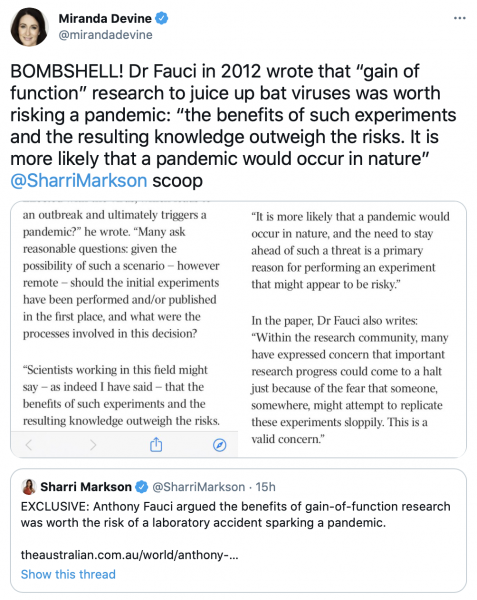
NOTHING TO SEE HERE, MOVE ALONG:  An explosive new study claims researchers found ‘unique fingerprints’ in COVID-19 samples that they say could only have arisen from manipulation in a laboratory. “Gain of Function involves tweaking naturally occurring viruses to make them more infectious, so that they can replicate in human cells in a lab, allowing the virus’s potential effect on humans to be studied and better understood. Dalgleish and Sørensen claim that scientists working on Gain of Function projects took a natural coronavirus ‘backbone’ found in Chinese cave bats and spliced onto it a new ‘spike’, turning it into the deadly and highly transmissible SARS-Cov-2. . . . Their new paper says these features of SARS-Cov-2 are ‘unique fingerprints’ which are ‘indicative of purposive manipulation’, and that ‘the likelihood of it being the result of natural processes is very small.'”

UPDATE:


Back In 1958 Communists Had 45 Goals to Take Over the U.S. Without Firing a Shot. Here Are the Ones They’ve Already Achieved

On 28 May Ian Fleming, The Creator Of James Bond, Was Born 


And today on 29 May - John Hatton the practicing real James Bond was born


The 1958 book by Cleon Skousen, The Naked Communist, set forth 45 goals communistsneed to achieve to take over the United States without firing a shot. Some of them are outdated and immaterial. Some are debatable. Let’s see how many commie goals have been achieved.


THE ENEMY WITHIN: In 1958 Communists Had 45 Goals to Take Over the U.S. Without Firing a Shot. Here Are the Ones They’ve Already Achieved.


A SHORT-TERM REMEDY AT BEST: Don’t count on caffeine to fight sleep deprivation, says study.