Police arrest five over $235m rorted from federal agencies including NDIA
Federal police say they have detected $235 million in actual or potential fraud from Commonwealth agencies, including the National Disability Insurance Agency.
Five people have been charged with fraud offences as part of months-long investigations into service providers accused of claiming government money for services they did not deliver.
What's next?
A number of the investigations have not resulted in arrests, but police are looking into multiple people of interest, including individuals linked to 10 Sydney-based NDIS providers.
EXCLUSIVE
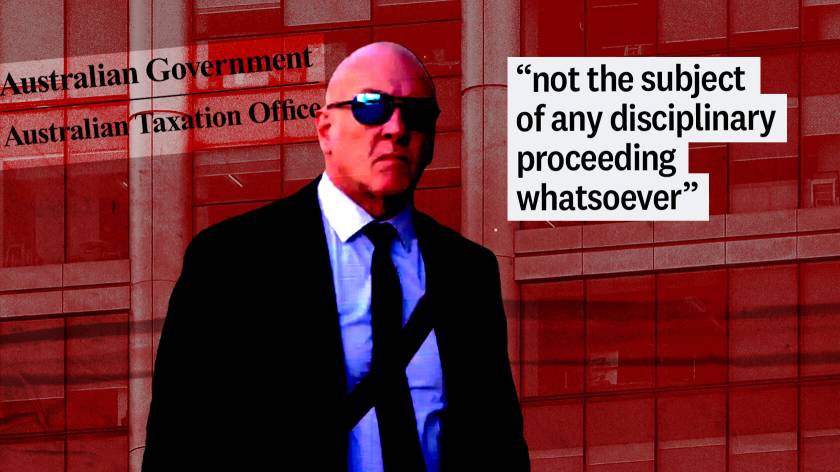
The Australian Tax Office (ATO) so spectacularly bungled a potential multimillion-dollar fraud investigation — through what the Queensland Court of Appeal described as the “disgraceful conduct” of its lead investigator — that Commonwealth prosecutors now have just 90 days to convince a court the case can proceed fairly.
The ATO has confirmed to Crikey that it is “engaged proactively” with the National Anti-Corruption Commission (NACC) to ensure an appropriate path of investigation.
The case centres around an alleged fraud by a Queensland woman whose company was involved in the development of therapeutic drugs. On October 30, three Queensland Court of Appeal justices delivered an excoriating rebuke to the ATO over its handling of the case.
The findings centre on the behaviour of a former lead criminal investigator for the ATO, Anthony Rains, whom the Appeal Court found acted with “deliberate dishonesty” by lying about key meetings between tax office auditors and the criminal investigation branch, doctoring crucial evidence and withholding other critical evidence from the respondent for five-and-a-half years.
“[His conduct] progressed to suppressing exculpatory evidence, to withholding evidence, to falsifying evidence in witness statements, and to deposing to misleading affidavits,” the appeal court found. “He did not correct false and misleading testimony or reveal he had materially altered an exhibit.
“As an experienced criminal investigator, he knew the prosecutor, the respondent and the court would be deceived by his misconduct. Ironically, Mr Rains did these things in proceedings where he was alleging the respondent had committed fraud.”
The appeal court stated the ATO failed to discipline Rains at any point after becoming aware of the misconduct and the findings of earlier proceedings. The tax office had admitted to some of those findings, though the subject of this appeal was essentially the ATO asking the court to ascribe to accident and mistake what an earlier judge had attributed to a pattern of deception.
“He was not the subject of any disciplinary proceeding whatsoever,” the appeal court found. “He left the role of criminal investigator voluntarily in 2022. At the time of the hearing before the primary judge [in late 2025], he was employed by the ATO as an intelligence analyst.”
Per the judgment, the Commonwealth lost every challenge made to the ten findings of fact against Rains.
“Mr Rains acted as if his primary obligation was to secure a conviction. His conduct was inconsistent with any concern for the fair administration of justice or the right of the respondent to a fair trial,” the court found.
“In short, Mr Rains’ actions corrupted the prosecution of the Commonwealth and the state [Queensland] charge. The officers of the ATO with responsibility for its management and operations did not prevent the misconduct, uncover it, or admit to it. The appellant, as an independent prosecution agency, failed to detect the misconduct, despite the respondent’s complaints.”
A spokesperson for the tax office told Crikey that Mr Rains is “no longer an ATO employee” after the findings of the primary judge in late 2025.
“Following the initial judgment, the ATO engaged proactively with the National Anti-Corruption Commission to ensure an appropriate path of investigation,” the spokesperson said in a statement. “The ATO is also seeking to better understand the basis for the court’s observations and will continue to pursue all appropriate avenues in response.”
‘The manufacturer does not exist’
An investigation into Queensland woman Julie Clarke [a pseudonym] began in early 2018 when tax officers became suspicious of some claims, including for almost $8.5 million in research and development tax credits, for work on a potential new drug and chemical compound.
This investigation was led from the beginning by Rains, who became the lead informant for the ATO, tipping off the Queensland Police Service to bring a state criminal case in advance of a Commonwealth alleged fraud matter.
The woman faced up to 20 years in prison if found guilty under the state case. However, by April 5, 2018, the “undisputed” findings from the primary Supreme Court of Queensland judge were that Rains “knew that most of the funds that would be subject of the state charge had been applied for legitimate expenses”.
After coming into early possession of emails, some of which “tended to support the [woman’s] defence to the state charge”, Rains withheld these from her legal team and her until November 2020.
Rains also misled the Queensland Police Service and the judiciary in preparing affidavits for search warrants. Additionally, despite becoming aware that there may well have been an overseas company that was legitimately paid for the supply of materials in the work of Clarke’s company — but which was misspelled with an “additional word and letter” on Clarke’s invoice — Rains did not pursue this.
The overseas company emailed him and confirmed that this was, in fact, the same family of companies on the invoice — giving the name of the colleague to verify this — but Rains never emailed the contact and instead persisted with his assertion that “the alleged manufacturer of the compound does not exist”.
In its appeal, the Commonwealth argued that regarding Rains’ conduct, beyond what it had already agreed to factually, the primary judge had erred by ascribing to it the motive of deliberate dishonesty. There was also no reason to prevent the Commonwealth prosecution from going ahead, it argued, because it had not permanently “oppressed” the woman’s right to a fair trial.
It argued Rains’ habit of not making records of sensitive meetings and otherwise damaging details in this case — including the failure to log a critical meeting in January 2018 in order to keep it secret — should be dismissed because record-keeping is an “onerous and frequently neglected task”.
This was just three years after the Royal Commission into the Robodebt Scheme made an explicit recommendation about standards of record-keeping in the Australian Public Service, for which officials ought already to be accountable under the Public Governance, Performance and Accountability Act.
“The court should not accept a submission that Commonwealth officers engaged in criminal investigations frequently neglect to comply with policies designed to preserve the integrity of their processes for the benefit of persons accused and the fairness of the court’s processes,” the appeal judges found.
“In any event, when an officer’s breaches of significant policies become commonplace, or even customary, they do not cease to be deliberate.
“It is consistent with other deliberate misconduct by Mr Rains. The concealment of misconduct was a continuation or elaboration of that misconduct, undertaken with a view to get away with it. There is no other compelling inference.”
‘Unconcerned by the serious misconduct’
Agreeing to allow the Commonwealth case to go ahead unfettered would, the appeal court found, “risk legitimising … the ATO’s misconduct, and damaging public confidence in the administration of justice”.
To do so would be to act “as if the court, like the appellant and the ATO, was unconcerned by the serious misconduct of Mr Rains”. Nevertheless, if there was serious fraud to be found — a circumstantial case, the appeal court suggested — then only truly exceptional wrongdoing would support a permanent stay.

The Commonwealth’s chances are not good on this score, but the appeal court justices have given the federal government just 90 days to propose “a satisfactory way” in which the prosecution can proceed.
Any trial, if it were ever to proceed, would also need to make the jury aware of Rains’ “disgraceful conduct”, the appeals court said.
The ATO’s spokesperson said that, after the primary judgment, it undertook a review to assure itself that the current framework for tax crime investigations was operating effectively and fairly.
“The review found that significant improvements had been implemented since the case to which the judgment relates, and that the current framework is sound and operating effectively,” the spokesperson said.
“The review also identified some opportunities for further improvement, all of which are being implemented. The ATO is also reviewing current matters that commenced prior to the implementation of the current framework to ensure appropriate oversight and consistency.”
About the author

Rick Morton
Correspondent-at-large
Rick Morton is a writer and reporter, publisher of the Nervous Laughter newsletter on Ghost, and author of the book Mean Streak about the robodebt scandal.