1 Day | 9 Stages
80 Acts
We fell together over a mutual love of standards, western swing, jazz and blues.


Dubbing a street ‘cool’ isn’t a walk in the park, but each year Time Out’s global team gives it a red-hot crack, uncovering the places people want to spend their time right now.
I've seen things you people wouldn't believe. Attack ships on fire off the shoulder of Orion. I watched C-beams glitter in the dark near the Tannhäuser Gate. All those moments will be lost, in time, like tears in rain. Time to die.
Men weren’t always “bad at friendship”
History has a solution for the male loneliness crisis.
Paul Ford made an app called Mouse Partyfor easily hosting video watching parties for your friends, no web server needed.
The 100 Best Indie Rock Albums of All Time. Includes albums by Death Cab for Cutie, Neko Case, Yeah Yeah Yeahs, Bon Iver, TV on the Radio, Arcade Fire, Broken Social Scene, Liz Phair, and Sonic Youth.
On his site Notes From the Road, Erik Gauger has a wonderful eight-part series on The Citrus Kingdom, a collection of illustrated stories about citrus fruit and Sicily.
Coffeehouses and the Scientific Revolution
Abstract Historians have long credited coffeehouses, venues for conversation where strangers met across social ranks, with fostering scientific contacts and activity during the Scientific Revolution. We test this claim in seventeenth-century London. Relying on newly geocoded records and a staggered event study across parishes, we find that the opening of the first coffeehouse in a parish is followed by a persistent increase in applied scientists and scientific instrument shops. Effects are concentrated among applied scientists with weak family ties to Oxford and Cambridge. Social connections that link craft skill to theory increase, and new shops turn toward experimental instruments. Across European cities in the seventeenth century, we similarly find that the numbers of applied mathematics titles and scientific instrument makers rise after a city’s first coffeehouse, relative to cities of similar size and growth. In a quantitative urban model calibrated to our parish- and city-level estimates, coffeehouses account for 31 percent of London’s applied scientists in the half century after the first one opened in 1652. These findings show that social institutions can raise the production and use of knowledge by broadening access to intellectual exchange beyond formal academic networks
That is a recent paper by Monir Bounadi and Jens Oehlen, noting that Bounadi is on the job market this year.
A Literary Map of the United States
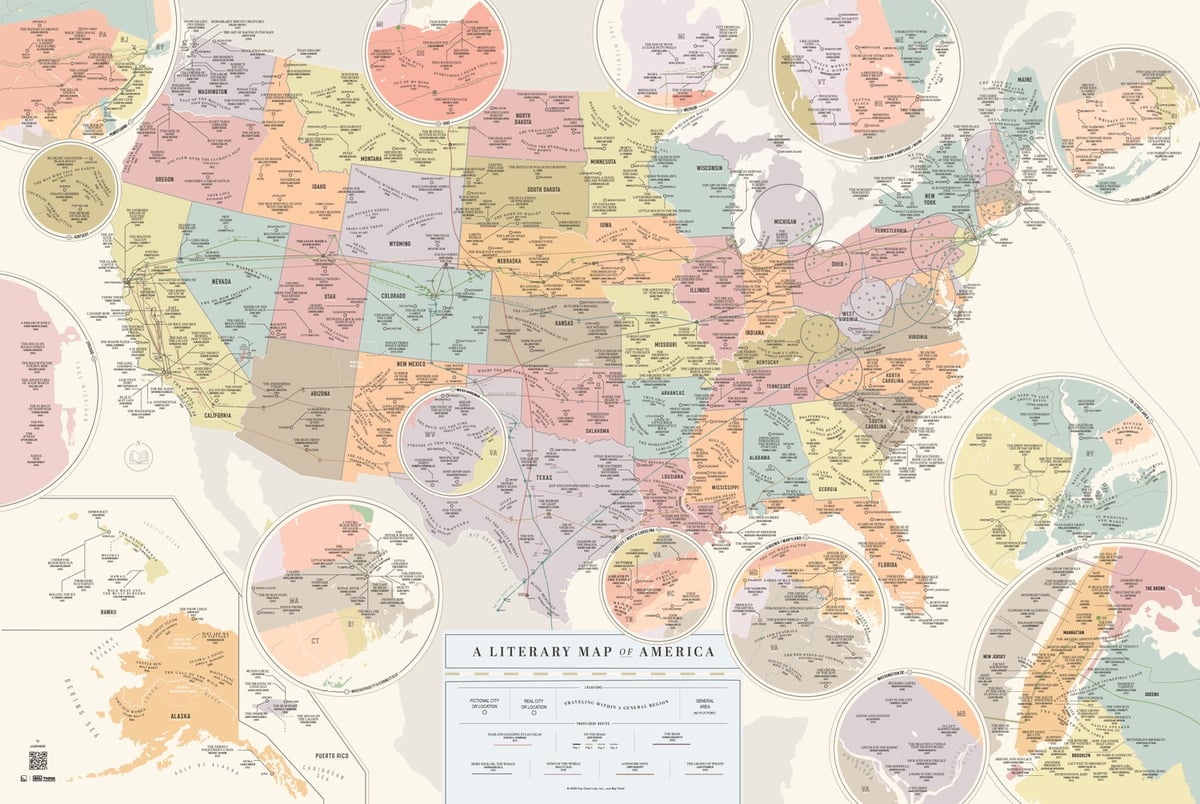
From Big Think and Pop Charts, A Literary Map of America that “highlights the real and imagined settings of hundreds of books”. Frank Jacobs takes a closer look at some of the imaginary places on the map, including Sleepy Hollow, Lake Wobegon, Brokeback Mountain, and F. Scott Fitzgerald’s East Egg and West Egg.
There are many ways to read this map: as a peculiar road map of the United States, a potted history of the same, a metatext of American literature, a guide to American literary genres and their centers of gravity, and more. I will get to at least some of them later, but for now, I want to examine the effect that scholars call broadly “imaginative geography,” more precisely “toponymic capture,” and more elegantly “authorial inscription.” It is the process by which a writer’s vision of a place becomes so dominant that it effectively overwrites that place’s prior identity in the public imagination.
We could say other parts of America have been “colonized” by other texts the same way King’s horror stories have influenced our perception of Maine. A gentler metaphor, from Rebecca Solnit’s Infinite City, is of cultural and literary memory as an “overlay.” It resides above physical geography like a transparency on an overhead projector, a slightly shifting but persistent presence.
In Landmarks, the English nature writer Robert Macfarlane develops the idea that a sufficiently powerful text doesn’t just describe a landscape, but alters the mind that subsequently encounters it. He uses the verb phrase “to see through” to define it: you see the Suffolk coast through W.G. Sebald, the Mississippi through Mark Twain, the South (as a particularly “Gothic” place) through Faulkner.