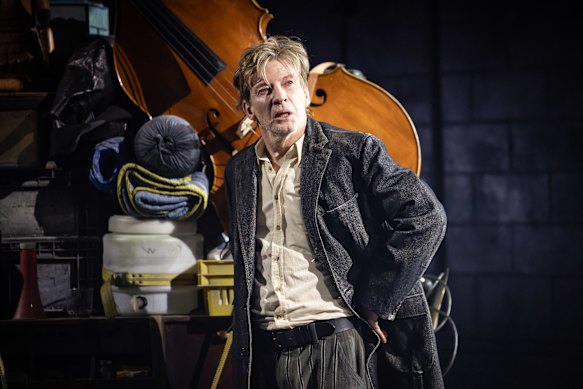
One man, 100 minutes, five stars: We’ll be talking about this play for years to come
April 18, 2026
AN ILIAD
Wharf 1 Theatre, April 17. Until June 21.
Reviewed by JOHN SHAND
★★★★★
We go to theatre in the hope of a night like this, where the words flare like fireworks, and insights become revelations; where suddenly the stage seems as limitless as life, and you watch and listen in wonderment.
An Iliad is that good.
Twenty-seven years after he last performed in Sydney, David Wenham floors us with his breadth of range and command of the stage. It’s a colossal role. For 100 minutes he’s only silent sometimes, when the gifted Helen Svoboda is singing and/or playing the double bass.
Lisa Peterson and Denis O’Hare’s adaptation of The Iliad premiered in New York in 2010, based on Robert Fagles’ sinewy, exhilarating translation of Homer. Damien Ryan, who was assistant director on William Zappa’s The Iliad Out Loud during the 2019 Sydney Festival, brilliantly directs this Sydney Theatre Company production.
This is a more formidable work of art. Peterson and O’Hare have hammered their text until they’ve compressed the birth song of the Western canon into its very essence: the insatiable rage of Achilles. He’s enraged into inaction in the Trojan War when his nominal king, Agamemnon, commandeers his “prize”, the beautiful Briseis, with whom he’s fallen in love, and then he’s enraged into action when Troy’s mighty Hector kills Patroclus, his other love.
Wenham’s character, the Poet, lives in our own times and therefore comments on rage and warfare from Troy to Iran. But the piece is not didactic, other than to say to us, “Such rage has never solved a problem before. Why should it solve one now?”
Wharf 1 Theatre is configured as half an amphitheatre, the stage and walls black. Wenham opens a roller shutter and wheels out a cart loaded with miscellany, including a double bass. From a suitcase he sprinkles sand to make the beach where the Greeks landed. From other cases emerges an arm that plays the bass, and then Svoboda materialises. Thereafter, her singing and playing are a constant reminder that An Iliad is indeed, as the Poet says, “a song”.
It’s a song that Wenham can make soar towards the heavens, or crunch like a boulder on a man’s chest. Among his array of voices he unleashes his full power as Achilles, and it’s as daunting as his shadow is monstrous on the wall behind. Just as suddenly he’s giving us a humorous travelogue tour of Troy, or Svoboda is relinquishing her bass to work a wooden puppet who is Hector’s baby son.
Together they recreate the cacophony of Bronze Age battle with bucket, chain and cymbals, and then Wenham is Hephaestus, making Achilles’ blazing new armour, or the messenger Hermes, represented by a pair of gold sandals.
Every scene, word and note carries meaning; carries the play forward to its end; to its death, if you like – except that this is among the rare deathless ones about which people will whisper for years to come.
